
 Media Buyer Planner notes that market information specialist TNS has purchased Sorensen Associates, the makers of PathTracker, video analysis software and other low- and high-tech solutions for retail media tracking and efficacy studies.
The combined company should be able to give the recently-created Nielsen In-Store a run for its money, and it certainly looks like the retail media measurement market will continue to be a hot segment through 2007. Part of the excitement comes from the In-Store Marketing Institute's PRISM measurement initiative, the first data from which we should be seeing shortly.
Since measurement is always the subject of great debate, multiple large companies have the opportunity to establish themselves as mindshare leaders, so TNS's acquisition of widely-respected Sorensen makes a lot of sense. Given that more established players means more ways to determine the efficacy of any one of the players, I certainly hope that the newly combined TNS/Sorensen can give VNU's Nielsen In-Store a run for its money.
Tags: Sorensen Associates, retail media, in-store media, TNS

Monday, February 26, 2007
TNS buys Sorensen to step up in-store media measurement efforts

Saturday, February 17, 2007
Should the pre-shopping phenomenon affect retail marketing plans?
Over at RetailWire Alan McClain did a nice writeup of a presentation by Deloitte & Touche's Pat Conroy did at the NRF this year. The most interesting piece of the whole thing:
A key finding of the survey was that 66 percent of store visits this holiday season were not influenced by advertising and marketing. Mr. Conroy said this is consistent with previous studies and shows that, to win shoppers, retailers need to deliver consistent shopping experiences and fulfill brand promises. In other words, previous shopping experiences are more important than advertising messages.Apparently, in an effort to save time and make shopping more efficient, more people are engaging in so-called pre-shopping techniques, like searching for a product or store information online before actually visiting the store. In fact, 61% if those surveyed by Deloitte did this kind of thing, which obviously means that push-based advertising and marketing takes a back seat to research (to some extent) in these cases.
The point that McClain raises at the end of this is whether retailers would be willing to take some portion of their traditional advertising budget and spend it more on cultivating customer relationships and improving the in-store experience. Obviously most retailers are hesitant to make "cuts" in t heir marketing budgets, but I think in this case most would need to be convinced that it would be more of a reordering of marketing priorities, and re-purposing of funds, maybe even by adding some portion of the new customer service and CRM initiatives into the marketing budget.
We've heard lots of stories before about shopping being an experience, a destination or a pastime. But the research presented by Deloitte suggests that some times, a shopping trip is more like a job or a task, where some analytical research at the beginning of the process can yield better results (in terms of total time and money spent), without much of an emotional appeal during the pre-shopping process (which, since it limits the amount of "actual" shopping time, also reduces the emotional component of the shopping trip itself).
I'm still of the opinion that most shopping trips can be broken down into one of these two categories (e.g. either "pastime" or "task"), however it also seems likely that elements of one can seep into the other. For example, shopping for a high-def TV, something that can only really be considered a non-essential luxury item, is going to have some emotional toll. Shoppers will visit one or more stores not just to look at different screens and check prices, but also to pick the brains of store employees, check out any necessary accessories, etc. Considering how big of a purchase it is, though, those same people will go home and do research on line, looking at customer reviews and competitor pricing before making a purchase decision. In this case, the "shopping" portion of the purchase process is still largely experience-driven. The "buying" portion, however, is more analytical in nature, and is thus more prone to the effects of pre-shopping (and maybe even post-shopping) research.
Tags: retail media, in-store experience, shopping, retail marketing
Tuesday, February 13, 2007
Cinema ads induce emotional buying effect
Hot on the heels of the news that cinema advertising company National CineMedia successfully completed its IPO comes this report from the Wise Marketer suggesting that the very type of ads the firm sells have been found to induce the emotional buying effect and create strong viewer involvement. The survey, conducted by ad research firm Ipsos ASI on behalf of cinema advertising firm Screenvision, was conducted in France and Spain to try and determine the power of emotions in cinema ad campaigns. The article notes:
It shows that the viewers are emotionally touched by the screen campaigns, which generate significant public involvement and strong positive emotions.In association with TV campaigns, screen advertising increases the quality and the impact of ad messages, reinforcing the viewers' will to purchase. The survey results show the relationship between emotions generated by screen advertising and the quality of the response to the advertisement.....
The survey was conducted among a representative population sample aged 15-60. It compared the responses of heavy cinema viewers who have watched a specific ad on screen in a cinema during the previous seven days with the responses of those who had seen the ad on TV only.
In both countries, heavy cinemagoers who had seen the cinema ad expressed fewer negative and passive feelings about the ad than those who had only seen it only on TV. In France, heavy cinemagoers felt 20% fewer negative and passive emotions than TV-only viewers. Positive and active emotions were 39% higher for heavy cinemagoers than for than for less frequent cinemagoers.
While Screenvision supplies both on-screen and off-screen advertising media for movie theaters, it sounds like this study primarily focused on the digital signage-like element where full-motion video (perhaps simply television commercials) are displayed on-screen before the movie begins. Using the same content would have allowed Ipsos ASI to determine what kind of effect the media had in the cinema versus only on TV.
Thursday, February 08, 2007
Experience design is not about brand experience
There's a good post (and even better comments) at Adaptive Path focusing on the difference between experience design and brand experience, and why so many people relate the two (when, the author suggests, they don't have anything to do with each other). The main thrust of his argument is basically that the word brand, "will always be about the impression companies want to make, and are by their nature an 'inside-out' proposition — a company figures out its brand and what it means, and does what it can to communicate or otherwise impart that message to people. Brand always starts with the company." On the other hand, "experience... needs to be about the people. What do they want to accomplish, achieve, do? For experience to succeed, it must start with the person, and from there, impress upon the company. 'Experience' is outside-in."
The inside-out versus outside-in concept fits well with my own attempts to figure out why retail marketers do the things that they do. For private label companies, the brand is everything: it's the stores, it's the people, it's the merchandise. But as the Adaptive Path post suggests, focusing on the brand would yield a totally "outside-in" approach, which wouldn't produce a very good experience for the average customer. It might be attractive, visually appealing, and so on, but wouldn't do a very good job of focusing on the customer's needs.
On the other hand, retailers that sell merchandise from multiple brands have a different problem, since they have to balance their own brand with the brands of all of their suppliers. The best retailers recognize the problem and try to adopt the "outside-in" experience approach that the article talks about, realizing that otherwise, they'd just be competing for attention with all of the "inside-out" branded goods.
How these realizations translate into actual design elements and innovations is different for every retailer (or at least that would explain how multiple retailers in the same category can have vastly different but still generate pretty good experiences).
Tags: store experience, experience design, branding, retail media
Iris scanning system IDs you without your knowledge
Minority Report lovers, rejoice! Soon all of the technology that you swoon over and refer to incessantly will be a reality, at least according to this article in LiveScience referring to a more advanced kind of optical iris scanning. According to the article:
A public iris scanning device has been proposed in a patent from Samoff Labs in New Jersey. The device is able to scan the iris of the eye without the knowledge or consent of the person being scanned. The device uses multiple cameras, and then combines images to create a single scan.Of course, that's a big problem -- right now, just for privacy advocates, but eventually it will become obvious that maybe it's not such a good idea to be immediately recognized and have your every movement logged. Granted, there's a long way from filing a patent application to actually having a commercially available product that does what it's supposed to, but apparently a similar system has already been tested with a reasonable amount of success, and given the variety of lucrative uses and abuses that such a system will allow, there's no doubt that it will continue to be refined.
Iris recognition is a biometric identification system that requires a high-resolution picture of the irides of the subject's eye. Pattern recognition software is then used to match that picture against future iris scans.
Tags: iris scanner, Minority Report, retail media
Monday, February 05, 2007
Shoppers showing signs of tunnel-vision
IGD just published another report on the state of shopping, and according to this summary at RetailBulletin, more shoppers are engaging in "selective shopping" techniques to cut down the amount of time they spend in stores. The authors cite increased time pressures as the primary driver for this kind of behavior, so it would seem like the greatest implications would be in grocery and dry goods stores, where most of the shopping is out of necessity, and not necessarily for entertainment purposes. Some of the other key takeaway points:
- 35% of shoppers visit only the aisles which they believe have the items they need, compared with 30% in 2003
- 25% of shoppers were willing to follow the in-store layout along each aisle, down from 28% in 2003
- 4% of shoppers take a haphazard approach and wander round aisles at random. This was up from 8% in 2003
- 25% are guided, and visit each aisle, regardless of whether they needed anything.
- 28% took this approach in 2003
- 35% are selective shoppers and only visit the aisles which they believe have the items they need. The figure in 2003 was 30%
- 26% are systematic, and follow the pattern of the aisles, unless they know the aisle contains nothing they need. 34% took this approach in 2003
Aside from locating new products or promoted items in key locations where simple math dictates that increased foot traffic will yield increased product exposures, these numbers also illustrate the importance that store layout, product packaging and retail media systems can have as shoppers become more focused on getting in and out of the store quickly.
Tags: store planning, retail media, shopping patterns, foot traffic
Tuesday, January 30, 2007
An interesting RFID experiment for cosmetics
StorefrontBacktalk has a very interesting article about an experiment in Japan involving retail chain Mitsukoshi, cosmetics company Shiseido and Fujitsu (the RFID vendor), where RFID tags are used to track when different cosmetics samples are tried, and to generate customized customer purchase histories, which would allow sales clerks to not only know which items a customer has purchased in the past, but also which they tried but opted not to buy. Also,
"the trial—involving retail chain Mitsukoshi, cosmetics company Shiseido and RFID vendor Fujitsu—also offers consumers a "virtual real-time makeup" session featuring a camera-equipped kiosk, display and RFID tag reader "that will enable customers to view on the display how particular products would look on their face by waving tagged cosmetic products such as lipsticks or eyeshadows over the tag reader," the companies said in a statement.Virtual cosmetics kiosks like this have been met with varying degrees of success in the past, but to me the RFID tracking of usage and purchase is the killer app here. I now have to wonder how the sales clerks will use the trial and purchase history information to improve customer service and/or promote key products.
Tags: RFID, digital merchandising, marketing at retail, purchase history
A look at experiential and branding-oriented digital signage networks
Over at our Dynamic Digital Signage and Interactive Kiosks Journal, we're looking at a number of different digital signage business models in an attempt to sort out where the best business opportunities lie for different specialty houses. Our first installment went out today, and it's a good fit for the broad concept of "in-store and retail media news," since it focuses on in-store media networks that are designed to build brand value instead of advertise particular products (which is what most people think about when they hear the words "digital signage", I think).
When we talk about experiential and branding networks, we're referring to digital signage displays that are designed to increase the impact of the host's brand and what it stands for. These are typically found in retail environments, but can be used in banks and other venues as well. Experiential networks are supposed to make the host environment more pleasant, improve the in-store experience and deliver imagery that highlights the core tenets of the brand -- without actually advertising the venue's wares directly. For example, think of Oakley, whose small, often spartan stores use plasma screens to show high-motion extreme sports and action clips (featuring Oakley-clad adventurers) that are just long enough to impart a sense of adventure and adrenaline without turning into a segment from ESPN. Or consider Nike's various in-store media networks that show edgy video, artistic images and unusual iconography in a visceral attempt to capture raw motion and skill, without necessarily promoting a particular sport, product or spokesperson.
A number of pros and cons are mentioned, along with our observation that unless you're the brand or a company already closely allied with the brand, these types of networks can be a very tough sell (and in fact, even if you're an internal champion at a brand-oriented company they can be a tough sell). So if these are the kinds of networks that interest you, you may want to check out the complete article:Digital signage networks: experience, branding and private label networks
Tags: digital signage, retail media networks, at-retail media, brand-building, advertising, marketing
Monday, January 29, 2007
Xanadu mega-mall redefines retail sponsorships
 The Xanadu Meadowlands mega-mall, when it finally opens some time in 2008, will be unique for several reasons. For one, it will be one of the biggest malls in the country (and certainly the biggest in the area). For another, it will be located along the extremely high-traffic segment of I95 in NewJersey close to the New York metro area. It will house the country's first indoor ski slope. And it will be built for branding from the ground-up.
According to this article in Advertising Age, the mall's owners, Colony Capital have maximized the number of marketing-related revenue streams from the project, from providing advertising opportunities on one of a dozen large-format outdoor electronic displays to making deals with up to five "presentation partners," who will be allowed to lend their name to a specific zone within the mall (imagine the "Cosmo GIRL! retail accessories wing", or maybe the "Coca-Cola Food Court"). While the idea seems to be just bizarre enough to be plausible, as Dave Yacullo, Director of Omnicom Group's Outdoor Media Group in New York notes, "it's really going to come down to how they can parlay those sponsorships into meaningful opportunities that would build the brand and move product."
Tags: Xanadu, Meadowlands, electronic billboards, out-of-home advertising, branding, naming
Wednesday, January 17, 2007
Flogging your brand at security checkpoints
 I'm not sure what to think of this. On the one hand, you've got to give these people credit for thinking of a clever way to turn bland, unsold space into a profit center. But on the other hand, as a consumer (and frequent traveler), I don't know if I'm going to have positive associations with any brands advertised during the agony of going through an airport security checkpoint.
The company's website claims that their products improve the checkpoint experience, according to ongoing trials that they've been running at Los Angeles' LAX, certainly one of my least-favorite airports, and the system has been approved for use by the TSA (whatever that entails).
Tags: out-of-home advertising, airport advertising, branding
Monday, January 15, 2007
RetailWire discusses the potential of in-store advertising
Once again, the folks at RetailWire are having another lively discussion about the future of in-store media. Retail media expert Laura Davis-Taylor leads this BrainTrust Query (free registration required) in an attempt to answer the question of whether digitally-based retail media networks need a unique team and/or skills to function and be utilized to their fullest extent. As usual, the discussion is quite good, and there are responses on both sides of the table. My favorite is from Mark Lilien, a consultant with Retail Technology Group, who argues in favor of a interdisciplinary team by noting that, "retailing technology success is often 1% strategy and 99% execution."
That's a hugely important (and accurate) thought that still isn't well understood by many struggling to implement their retail media programs. The work that goes into up-front strategy is quickly surpassed by the work needed to implement and subsequently maintain any form of retail digital media, whether it be audio, video or interactive. Just because a medium is digital doesn't mean that it can lose it's relevancy or timeliness. Likewise, marketers would be wise to listen to the opinions of their customers during a retail media pilot, and consider making adjustments accordingly.
By my totally unscientific estimate, I believe that most retail media networks (digital signage in particular) are probably only utilized at 75% or less of their maximum efficiency (however one might measure that), since almost every network that I've looked at could benefit from some sort of improvement or other. Still, there are many who believe that once a network is deployed, it's finished, and the rest is up to the content guys. While that mentality might allow some networks to stay successful over time, there's almost always something that could be done to make it a little better for the consumer, and better performing for the retailer.
Tags: retail media, digital signage, in-store media, in-store advertising
Friday, January 12, 2007
Just say No to Interruption Marketing
With all of the hoopla surrounding the recent rise of in-store media like digital signage and retail audio networks, it can be easy to forget that for every cool, innovative and successful projects there are any number that not only don't meet their objectives, but also go one step further and irritate shoppers. For all those projects, David Meerman Scott has started an Interruption Marketing Hall of Shame at Web Ink Now. A frequent traveler, David's top three inductees are all related to airports. For example, look at what he has to say about his #2 pick, CNN, for their CNN Airport Network:
CNN has created this crap so they make the Hall of Shame. I actually like CNN, but only when I choose to watch it (usually while I am on my exercise machine at home). I don't want to watch (listen) all the time. CNN should have a clause in the contracts that they write with airports for the CNN Airport Network that says that quiet areas must be made available in every terminal that installs their network. Listen up CNN: You are hurting your brand with this nonsense.Pretty strong words (I don't particularly mind CNN Airport Network myself), but there certainly are cases where less would have been more, and an otherwise good marketing opportunity becomes an annoyance. For example, #4 on David's list, Simon Property Group, is an example that I agree with. When Simon and Publicis Group announced that they were creating a digital signage network to be featured in malls, we all wondered what form it might take. After witnessing it first hand this holiday season, I must say I'm underwhelmed. In order to compete for attention over the cacaphony, the in-concourse screens blare audio that often just smashes up against audio coming from the different mall stores. In the food court, the screens are poorly placed (in the malls I visited, at least), and while not particularly loud or obnoxious compared to the already deafening noise that food courts are known for during peak traffic times, I can only imagine that when it's quieter they would be.
Retail marketing should not be interruption marketing. Retail media networks should complement the store environment, not stand apart from it in an attempt to be seen and heard. I think this is one of the biggest mistakes still being made in the retail media space today, and it's the reason why so many are still wary of using these systems in store.
Tags: retail media, in-store media, advertising, digital signage
Friday, January 05, 2007
A gift for germophobes: a shopping cart disinfectant system
 I'm a strong believer in washing your hands after you sneeze. Likewise, I have a little bottle of Purel hand sanitizer sitting on my desk. And at Publix (my local supermarket), I've taken to using the complementary hand wipes that they leave at the door on the way out.
Now, though, I've learned that's not enough, since according to this article at Storefront Backtalk, shopping carts at such places, "are never clean. They are covered in meat and poultry juices, a leaky toddler’s diaper and other germs." The solution, you ask? Well, Jim Kratowicz, president of PureCart Systems LLC (and provider of that quote), suggests his PureCart system, which uses a hydrogen peroxide-based solution to reportedly kill 99.99% of bacteria and more than 90% of viruses.
Tags: shopping carts, PureCart Systems
Thursday, January 04, 2007
Looking for RFID ROI
There's a nice thread on RetailWire about the ups and downs of RFID, which was once heralded as the greatest thing since the barcode, but is currently still looking for a place to truly shine. As Chantal Polsonetti, VP of Manufacturing Advisory Services for Arc Advisory Group notes, many manufacturers don't expect massive supply chain benefits by implementing RFID systems, and instead are looking for secondary benefits to drive ROI:
"Our manufacturing customer base is telling us they already have sophisticated supply chains, so the benefit from RFID in the distribution center is incremental at best," she told Modern Materials Handling. "Instead, they're looking at applications around asset tracking, work-in-process and how product moves through the retail store to get an ROI."
Back-office applications still seem like the best fit for RFID, though there are certainly numerous applications that could benefit from the extra awareness that an integrated RFID system brings, and NCR has suggested some ways that RFID could be used to improve the in-store experience. Still, until consumer trust in the technology improves and certain security issues are resolved, I expect that RFID will continue to have more to do with tracking boxes in a warehouse than helping a shopper locate products in store.
AddMirror brings retail media to the narcissist
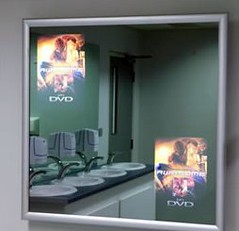 MediaSoon notes that UK ambient advertising company Addirect is selling a pretty cool-looking media system called Addmirror, which places backlit images behind a partial (2-way) mirror. When the backlight is turned off, the mirror looks completely normal. When the backlight turns on, the image suddenly appears. Multiple areas can be lit up at once, or you can cycle through different lit areas to show different images on different parts of the mirror.
I've seen similar digital signage systems before, (in fact one of our resellers wired up a bunch of high-end beauty salons with LCDs behind partial mirrors so that people could watch TV while getting a haircut), but there's something to be said for the simplicity of a static-image system like this.
Tags: retail media, ambient media, retail marketing, advertising
 Subscribe to this blog