Tuesday, January 30, 2007

An interesting RFID experiment for cosmetics

StorefrontBacktalk has a very interesting article about an experiment in Japan involving retail chain Mitsukoshi, cosmetics company Shiseido and Fujitsu (the RFID vendor), where RFID tags are used to track when different cosmetics samples are tried, and to generate customized customer purchase histories, which would allow sales clerks to not only know which items a customer has purchased in the past, but also which they tried but opted not to buy. Also,

"the trial—involving retail chain Mitsukoshi, cosmetics company Shiseido and RFID vendor Fujitsu—also offers consumers a "virtual real-time makeup" session featuring a camera-equipped kiosk, display and RFID tag reader "that will enable customers to view on the display how particular products would look on their face by waving tagged cosmetic products such as lipsticks or eyeshadows over the tag reader," the companies said in a statement.
Virtual cosmetics kiosks like this have been met with varying degrees of success in the past, but to me the RFID tracking of usage and purchase is the killer app here. I now have to wonder how the sales clerks will use the trial and purchase history information to improve customer service and/or promote key products.

Tags: RFID, digital merchandising, marketing at retail, purchase history

A look at experiential and branding-oriented digital signage networks

Over at our Dynamic Digital Signage and Interactive Kiosks Journal, we're looking at a number of different digital signage business models in an attempt to sort out where the best business opportunities lie for different specialty houses. Our first installment went out today, and it's a good fit for the broad concept of "in-store and retail media news," since it focuses on in-store media networks that are designed to build brand value instead of advertise particular products (which is what most people think about when they hear the words "digital signage", I think).

When we talk about experiential and branding networks, we're referring to digital signage displays that are designed to increase the impact of the host's brand and what it stands for. These are typically found in retail environments, but can be used in banks and other venues as well. Experiential networks are supposed to make the host environment more pleasant, improve the in-store experience and deliver imagery that highlights the core tenets of the brand -- without actually advertising the venue's wares directly. For example, think of Oakley, whose small, often spartan stores use plasma screens to show high-motion extreme sports and action clips (featuring Oakley-clad adventurers) that are just long enough to impart a sense of adventure and adrenaline without turning into a segment from ESPN. Or consider Nike's various in-store media networks that show edgy video, artistic images and unusual iconography in a visceral attempt to capture raw motion and skill, without necessarily promoting a particular sport, product or spokesperson.

A number of pros and cons are mentioned, along with our observation that unless you're the brand or a company already closely allied with the brand, these types of networks can be a very tough sell (and in fact, even if you're an internal champion at a brand-oriented company they can be a tough sell). So if these are the kinds of networks that interest you, you may want to check out the complete article:Digital signage networks: experience, branding and private label networks

Tags: digital signage, retail media networks, at-retail media, brand-building, advertising, marketing

Monday, January 29, 2007

Xanadu mega-mall redefines retail sponsorships

The Xanadu Meadowlands mega-mall, when it finally opens some time in 2008, will be unique for several reasons. For one, it will be one of the biggest malls in the country (and certainly the biggest in the area). For another, it will be located along the extremely high-traffic segment of I95 in NewJersey close to the New York metro area. It will house the country's first indoor ski slope. And it will be built for branding from the ground-up.

According to this article in Advertising Age, the mall's owners, Colony Capital have maximized the number of marketing-related revenue streams from the project, from providing advertising opportunities on one of a dozen large-format outdoor electronic displays to making deals with up to five "presentation partners," who will be allowed to lend their name to a specific zone within the mall (imagine the "Cosmo GIRL! retail accessories wing", or maybe the "Coca-Cola Food Court"). While the idea seems to be just bizarre enough to be plausible, as Dave Yacullo, Director of Omnicom Group's Outdoor Media Group in New York notes, "it's really going to come down to how they can parlay those sponsorships into meaningful opportunities that would build the brand and move product."

Tags: Xanadu, Meadowlands, electronic billboards, out-of-home advertising, branding, naming

Wednesday, January 17, 2007

Flogging your brand at security checkpoints

I'm not sure what to think of this. On the one hand, you've got to give these people credit for thinking of a clever way to turn bland, unsold space into a profit center. But on the other hand, as a consumer (and frequent traveler), I don't know if I'm going to have positive associations with any brands advertised during the agony of going through an airport security checkpoint.

The company's website claims that their products improve the checkpoint experience, according to ongoing trials that they've been running at Los Angeles' LAX, certainly one of my least-favorite airports, and the system has been approved for use by the TSA (whatever that entails).

Tags: out-of-home advertising, airport advertising, branding

Monday, January 15, 2007

RetailWire discusses the potential of in-store advertising

Once again, the folks at RetailWire are having another lively discussion about the future of in-store media. Retail media expert Laura Davis-Taylor leads this BrainTrust Query (free registration required) in an attempt to answer the question of whether digitally-based retail media networks need a unique team and/or skills to function and be utilized to their fullest extent. As usual, the discussion is quite good, and there are responses on both sides of the table. My favorite is from Mark Lilien, a consultant with Retail Technology Group, who argues in favor of a interdisciplinary team by noting that, "retailing technology success is often 1% strategy and 99% execution."

That's a hugely important (and accurate) thought that still isn't well understood by many struggling to implement their retail media programs. The work that goes into up-front strategy is quickly surpassed by the work needed to implement and subsequently maintain any form of retail digital media, whether it be audio, video or interactive. Just because a medium is digital doesn't mean that it can lose it's relevancy or timeliness. Likewise, marketers would be wise to listen to the opinions of their customers during a retail media pilot, and consider making adjustments accordingly.

By my totally unscientific estimate, I believe that most retail media networks (digital signage in particular) are probably only utilized at 75% or less of their maximum efficiency (however one might measure that), since almost every network that I've looked at could benefit from some sort of improvement or other. Still, there are many who believe that once a network is deployed, it's finished, and the rest is up to the content guys. While that mentality might allow some networks to stay successful over time, there's almost always something that could be done to make it a little better for the consumer, and better performing for the retailer.

Tags: retail media, digital signage, in-store media, in-store advertising

Friday, January 12, 2007

Just say No to Interruption Marketing

With all of the hoopla surrounding the recent rise of in-store media like digital signage and retail audio networks, it can be easy to forget that for every cool, innovative and successful projects there are any number that not only don't meet their objectives, but also go one step further and irritate shoppers. For all those projects, David Meerman Scott has started an Interruption Marketing Hall of Shame at Web Ink Now. A frequent traveler, David's top three inductees are all related to airports. For example, look at what he has to say about his #2 pick, CNN, for their CNN Airport Network:

CNN has created this crap so they make the Hall of Shame. I actually like CNN, but only when I choose to watch it (usually while I am on my exercise machine at home). I don't want to watch (listen) all the time. CNN should have a clause in the contracts that they write with airports for the CNN Airport Network that says that quiet areas must be made available in every terminal that installs their network. Listen up CNN: You are hurting your brand with this nonsense.
Pretty strong words (I don't particularly mind CNN Airport Network myself), but there certainly are cases where less would have been more, and an otherwise good marketing opportunity becomes an annoyance. For example, #4 on David's list, Simon Property Group, is an example that I agree with. When Simon and Publicis Group announced that they were creating a digital signage network to be featured in malls, we all wondered what form it might take. After witnessing it first hand this holiday season, I must say I'm underwhelmed. In order to compete for attention over the cacaphony, the in-concourse screens blare audio that often just smashes up against audio coming from the different mall stores. In the food court, the screens are poorly placed (in the malls I visited, at least), and while not particularly loud or obnoxious compared to the already deafening noise that food courts are known for during peak traffic times, I can only imagine that when it's quieter they would be.

Retail marketing should not be interruption marketing. Retail media networks should complement the store environment, not stand apart from it in an attempt to be seen and heard. I think this is one of the biggest mistakes still being made in the retail media space today, and it's the reason why so many are still wary of using these systems in store.

Tags: retail media, in-store media, advertising, digital signage

Friday, January 05, 2007

A gift for germophobes: a shopping cart disinfectant system

I'm a strong believer in washing your hands after you sneeze. Likewise, I have a little bottle of Purel hand sanitizer sitting on my desk. And at Publix (my local supermarket), I've taken to using the complementary hand wipes that they leave at the door on the way out.

Now, though, I've learned that's not enough, since according to this article at Storefront Backtalk, shopping carts at such places, "are never clean. They are covered in meat and poultry juices, a leaky toddler’s diaper and other germs." The solution, you ask? Well, Jim Kratowicz, president of PureCart Systems LLC (and provider of that quote), suggests his PureCart system, which uses a hydrogen peroxide-based solution to reportedly kill 99.99% of bacteria and more than 90% of viruses.

Tags: shopping carts, PureCart Systems

Thursday, January 04, 2007

Looking for RFID ROI

There's a nice thread on RetailWire about the ups and downs of RFID, which was once heralded as the greatest thing since the barcode, but is currently still looking for a place to truly shine. As Chantal Polsonetti, VP of Manufacturing Advisory Services for Arc Advisory Group notes, many manufacturers don't expect massive supply chain benefits by implementing RFID systems, and instead are looking for secondary benefits to drive ROI:

"Our manufacturing customer base is telling us they already have sophisticated supply chains, so the benefit from RFID in the distribution center is incremental at best," she told Modern Materials Handling. "Instead, they're looking at applications around asset tracking, work-in-process and how product moves through the retail store to get an ROI."

Back-office applications still seem like the best fit for RFID, though there are certainly numerous applications that could benefit from the extra awareness that an integrated RFID system brings, and NCR has suggested some ways that RFID could be used to improve the in-store experience. Still, until consumer trust in the technology improves and certain security issues are resolved, I expect that RFID will continue to have more to do with tracking boxes in a warehouse than helping a shopper locate products in store.

Tags: RFID, ROI, in-store experience, supply chain management

AddMirror brings retail media to the narcissist

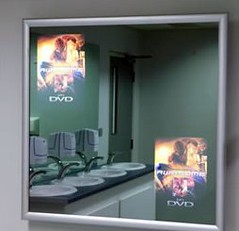
MediaSoon notes that UK ambient advertising company Addirect is selling a pretty cool-looking media system called Addmirror, which places backlit images behind a partial (2-way) mirror. When the backlight is turned off, the mirror looks completely normal. When the backlight turns on, the image suddenly appears. Multiple areas can be lit up at once, or you can cycle through different lit areas to show different images on different parts of the mirror.

I've seen similar digital signage systems before, (in fact one of our resellers wired up a bunch of high-end beauty salons with LCDs behind partial mirrors so that people could watch TV while getting a haircut), but there's something to be said for the simplicity of a static-image system like this.

Tags: retail media, ambient media, retail marketing, advertising

Thursday, December 14, 2006

Could Google bring user-created content into retail stores?

A few months ago I speculated that Google and YouTube could team up to deliver low-cost content to the thousands of digital sign networks out there that can't afford full-time custom content creation. Just yesterday there was an interesting article about automatic video tagging that I blogged about at Digital Signage News, in fact, that added to this speculation.

Today, it seems, would be a good day to add even more fuel to the fire, in the form of two ads about real companies utilizing low-budget content, and another about Google's foray into radio advertising. First is this article from AdvertisingAge about Dove solicing ads from consumers. AdAge notes:

In an e-mail today to members of its online relationship-marketing program, Dove began seeking entries for a 30-second ad to promote a new product, Dove Cream Oil Body Wash.

The e-mail directs people to DoveCreamOil.com, a site hosted on Time Warner's AOL, which provides online tools, artwork, photos and music for creating ads, and also allows consumers to upload their own files. "You don't need any special skills or experience," the e-mail says.
The second article is from arch-rival AdWeek, and focuses on Southwest Airlines, who is also asking for user-generated content to incorporate into its TV advertising campaign. Southwest is actually partnering with YouTube to collect 20 user-submitted embarrasing situations to include in its "Wanna Get Away" campaign. And in fact AdWeek notes a few other examples where name-brand CPGs have experimented with user-generated content:
Doritos is currently running a contest with Yahoo that will air a user-submitted video during the Super Bowl. Chevrolet, Sony and Converse are also experimenting with the concept.

A Chevy Tahoe promotion that let consumers create their own executions pointed to the risks of the tactic. Environmentally minded users created several ads lambasting the SUV for its effect on the environment.
And how would a hypothetical GooTube or Tooble get all of this gr
eat content from the Internet to a bunch of in-store displays without a lot of administrator intervention? Well, that's where this last article from ClickZ comes in. Google is finally putting its acquisition of dMarc to good use, and allowing a current pool of 700 radio stations to subscribe to its AdWords-like service for radio. The article states:
Google Audio Ads are sold on a CPM basis through the AdWords platform, and advertisers can target on factors like geographical market and time of day. Reporting functions disclose which stations ran ads and when, and real-time air checks are available, a bit of a novelty for interactive marketers who have grown used to not seeing their non-search executions.
The retail media market is still to immature for Google to put a lot of effort behind it, but it's certainly coming, and with brands getting on board behind user-created content (and the ongoing march of progress over at Google), I'm willing to bet that within a few years there will be little distinction between how Google and others supply Internet, radio, TV and retail media spots and fill out inventory.

One last (and quick) update: No sooner had I published this post than I came across David Polinchock's post about Martin Sorrell's take on Google (he calls them the "frienemy"). Great article, go check it out, and read the other article that he references about Google and ad agencies.

Tags: Google, YouTube, dMarc, digital signage, retail media, out-of-home advertising

Tuesday, December 05, 2006

VNU To Develop In-Store Measurement Service

After creating quite the commotion about it's P.R.I.S.M store media measurement technique, VNU has decided to take the service live, doing what it calls the "lead-market phase" of the new service in early 2007, with full availability later in the year. From the press release:

The new service, which will be developed through a new unit of VNU known as Nielsen In-Store, will measure consumer exposure to a fast-growing and powerful array of in-store marketing vehicles, including television and radio, shelf talkers, digital signage, and other point-of-purchase displays. Collectively, these in-store marketing approaches stand as the sixth largest advertising vehicle in the U.S., at $18.6 billion in spending in 2005.

The new service will also help retailers improve results through better store layouts, category adjacencies and product selection. “The new information we provide for retailers and manufacturers will help them work more effectively to improve the shopping experience for consumers,” said George Wishart, who has been named global managing director of Nielsen In-Store. “We also will provide the advertising, media and retail industries with a new currency standard that can increase the efficiency of the media buying and selling process.”
The same big names featured in the pilot project are endorsing the full-scale system, suggesting that early results were good. Members of the consortium include 3M, Coca-Cola, Kellogg’s, Miller Brewing, Procter & Gamble and The Walt Disney Company, as well as major retailers like Albertsons, Kroger, Walgreens and Wal-Mart.

(Cross-posted at the digital signage news blog)

Tags: VNU, P.R.I.S.M, retail media, media measurement, in-store advertising

Thursday, November 30, 2006

Wal-Mart names Roces to head ‘Store Experience’

Home Textiles has a brief blurb about the appointment:

Wal-Mart Stores is creating a new organization it calls “Store Experience” to delve more deeply into store planning, space management, and the retailer’s store-of-the-community initiative.

Santiago Roces, who was most recently Wal-Mart’s Korea president, will be leading the initiative. He is relocating to company headquarters in Bentonville, Ark. Roces’ promotion is one of several appointments that make up Wal-Mart’s recently restructured marketing “dream team,” explained John Fleming, evp and chief marketing officer, during Wal-Mart’s presentation Wednesday at the Morgan Stanley Global Consumer & Retail conference here.
Tags: ,

Luxury auto dealerships invest in good design

While consumer retail garners the most attention when it comes to in-store media, a lot is going on in the retail automotive sector that deserves some commentary as well. My company has been working in that space for about four years now, installing both interactive kiosks and digital signs into hundreds of US dealers, and big chains like AutoNation have also invested in chain-wide digital media networks.

USA Today apparently noticed the trend, as they published this article about the lengths that luxury retail auto dealers are going to in order to bring their dealerships up to snuff. They note:

At Fletcher Jones Motorcars, customers stroll through a gallery of Mercedes-Benzes, linger at the cappuccino bar, tap balls on the putting green or go for a pedicure.

A couple of blocks away, Newport Lexus boasts marble fireplaces, Oakley and Tommy Bahama beachwear boutiques — and a flat-screen television, tuned to ESPN, of course, mounted above the urinal in the men's room.

The two dealerships are pouring on the fancy fixtures and service extras as they vie for a larger share of one of the nation's most prosperous luxury-car markets, coastal Orange County. But even far from "The O.C.," auto industry officials see the sprucing up of luxury-car dealers as a sign that the high-end market could finally be brightening.

I don't know if I'd particulary want a pedicure from my auto dealer, but it's certainly interesting to see that retail design is being used as a gauge for market performance.


Tags: , , ,

Uniqlo injects Eastern design into western retail

Japanese clothing retailer Uniqlo falls into the same category as H&M for me -- a trendy-looking store that I'd never actually buy anything in, but is visually appealing and shoppable nonetheless. Apparently I'm not the only one to think so either (well, the looks cool part, anyway, I'm sure these stores are heavily shopped), since BusinessWeek decided to do an article on their approach to retail design a few weeks ago. Semi-famous retail architect Masamichi Katayama designed the New York flagship store that's getting all the attention, and in the article he describes the store's "Japanese-ness" as "seiriseiton, " which he then further translates into "simplicity" and "orderliness."

While spartan layouts and stylish fixtures have long been present in tiny boutiques and haute couture specialty retailers, Uniqlo is trying to blend their casually trendy offerings with a high style, dare I say upscale retail design that oozes with simplicity and orderliness. From what I've seen, I certainly think they've met their design goals.

Tags: , ,

Making an emotional appeal with in-store media

Note: I've cross-posted this to the Digital Signage News blog, since the subscriberships seem to be somewhat different (and unrelated).

Institutions spend too much time focusing on the science of shopping, rather than the art of shopping. So says The Integer Group's Meg Kinney in her article "The Art of Shopping," featured in the November/December issue of HUB Magazine. While that sentence might not appear to make a lot of sense on the surface (since when is shopping an art or a science, anyhow?), Kinney looks at the growing number of retailers who are focusing on ways to enhance the in-store experience, and comes to some interesting conclusions about what needs to be done to bring in-store media up to snuff in today's experiential retail environment.... Read the full article: Making an emotional appeal with in-store media

Tags: , , , ,