Showing posts with label advertising. Show all posts

Thursday, September 11, 2008

Gentle guidance is good marketing

Recently, Mass Mutual launched a new set of ads that they’ve been describing as “thoughtful.” When was the last time you heard a marketing campaign that was “thoughtful?” Aggressive, creative, innovative, suave, - sure, marketing comes up with every adjective possible, but "thoughtful" could mean you actually want people to think about what’s been sold.

That, I suppose, could be dangerous.

In reality, Mass Mutual’s newest campaign is much more than thoughtful. It’s smart. Taking back the notion of what really counts in life from those annoying MasterCard “priceless” ads, these spots show people making what are, subjectively, good decisions in their everyday lives. According to Forbes,

The campaign is an extension of the company's core position and tagline -- "We'll help you get there(sm)" -- that underscores the company's understanding of the real, practical issues consumers face when it comes to life insurance and retirement, and positions MassMutual as the company that helps consumers take the steps that are right for them.

Creative executions pose the philosophical and practical question: "What is the sign of a good decision?" The decisions captured in the executions are all real, almost everyday scenarios, like cutting short a fishing excursion to head for safe harbor at the first sign of a storm. Like real life financial decisions, the scenarios depicted all have consequences that can affect people beyond just the decision-maker. The campaign illustrates the value and confidence that come with making sound decisions for individuals and families, small business owners or plan managers at major corporations.
It doesn’t hurt that the ads have great soundtracks behind them (Bob Dylan on the one where a father decides to move his top-of-the-skyscraper-amazing-city-view office to his home after looking at a picture of his young daughter). Or that MassMutual puts a lot of family-friendly policies to the test in its own workplace. They've also sponsored a two-part documentary on PBS about retirement decisions and financial stability.

From a retail and advertising standpoint, engendered trust and a sense of guidance are some of the most difficult things to “sell” to customers. Not to mention that the company aims to do this at a time when established financial institutions are in trouble one way or another. The emphasis on gentle guidance is what works here – moving away from the hard sell to the simple straightforward assurance is the right move, especially for a company that could, in fact, play on people's anxieties in an anxious time. You can bet this approach won’t be appearing all over the advertising landscape, but it might not hurt for companies to stop and consider what exactly they have to offer that would make consumers choose one brand, one company over another. Brand loyalty is, of course, better if it’s actually earned.

Tags: , ,

Thursday, August 14, 2008

Cookies, grass, and other stuff: giving 'multimedia' a whole new meaning

Whether digital or not, alternative out-of-home formats are exploding as advertisers try to catch consumers during those few precious minutes between work and home (or anywhere and home, for that matter), when their guards might be down and they might be a little bit more receptive to viewing ads.

So aside from digital, what other kinds of things fall under the 'alternative' umbrella, you ask? Well, a few recent ad campaigns were highlighted in the New York Times and other media for their uniqueness, always creative, though not always directed entirely at a point-of-sale:

My favorite involve unusual sites and familiar materials. One was a giant Oreo cookie decal on the side of a glass elevator that dunked into a giant decal of a glass of milk on the exterior of the bottom. The giant dunking Oreo is gone now, but the You Tube video is still popular.

Another great example is from Wimbledon, where the firm J. Walter Thompson hired UK-based artists Heather Ackroyd and Dan Harvey to create grass portraits of three figures in the tennis world. The process involves exposing the seeds to different amounts of light in order to get shadings of green, creating a kind of negative effect, varied by the length of the grass. The campaign originally involved planting grass in other sites (bus stations) to highlight Wimbledon’s uniqueness, but the company ended up using artificial turf (which, of course, is precisely what’s NOT in Wimbledon). Either way, the portraits have gotten Ackroyd and Harvey some attention and while it may not have directly increased revenue for the tournament, it did put it back in the news.

The Times also noted Papa John's giant pizza construction, which is designed to bring attention to their new whole wheat crust. While I think giant food is always fun, I'm not sure it's in the best taste at the moment, where people are beginning to strain to fill their supermarket carts.

For some other companies, it’s not about where the ad is placed or how it’s constructed, but the stories being told. Using a format similar to “This American Life,” KeyBank is running a new version of testimonial ads that are designed to encourage people to figure out how to manage your money. In a timely fashion, one ad features an animated video voiced over by U.S. Olympic swimmer Diana Munz who tells how she decided where to keep her gold medal:

As she tells her story, animation depicts her storing the medal in a clam, à la a pearl, putting the clam in a blowfish and having the blowfish swallowed by a secure steel whale. Instead, she opts to put it in a KeyBank safe deposit box. Other spots depict a man's decision-making process on how to finance a home remodel, and another family's work to create college savings funds.
All three of these campaigns do something unique, but all three tell a story, whether it’s a short familiar one (Oreo into milk) or a more complicated one (taking care of you money), it’s all about using different tactics to engage the jaded viewer.

Tags: , ,

Sunday, August 03, 2008

Mad Men and mind reading

AMC’s series Mad Men has been generating a lot of positive attention from critics lately. It’s a slick show set in the 1960s that follows the experiences of Madison Avenue Advertising Executives and the people around them. The New York Times review captures what everyone likes about it:

The advertising executives, who called themselves “mad men,” were at the front of the consumer rat race, hypnotizing the American buyer with huckster campaigns created off-the-cuff in smoky meeting rooms or on a cocktail napkin at El Morocco…. The advertising business was flush, blissfully unburdened by aging readerships, failing newspapers, DVRs or the Internet, and only barely accountable to the federal government or public opinion.

That kind of unbridled freedom is the series’s one speck of sentiment, evoking nostalgia for a time before the current audience-knows-best rule of business, in which viewers vote on who gets to become a pop star, publishers ask readers to choose their authors, and politicians ask viewers to decide what issues they should discuss, as is the plan in next week’s live Democratic debate, a joint project between CNN and YouTube. When Don Draper (Jon Hamm), the suave creative director of the Sterling Cooper Advertising Agency, receives consumer data from the research director that suggests there is no way to avoid addressing Americans’ concerns about the health risks of smoking, Don coolly drops the report in his wastepaper basket.
While some of the big agencies are still run by a few iconic personalities, for the most part it's quite different today. While at one time the industry might have been enthralled with some new creative campaign, data, analytics and big business practices grab the lion's share of headlines these days. Case in point: Brandweek reports that its parent company, Nielsen is partnering with Mindset Media to develop a method of tying consumer behavior (actual purchases) to behavioral data (personality mapping). The idea is to expand Nielsen’s ability to target types of consumers beyond surface demographic information. Retailers may know who buys what, but it’s hard to link that information with good answers to the “why” question.

Personality profiling is nothing new – and certainly the rise of the psychological mindset was important to advertising in the 50s and 60s, too. But today, agencies and retail companies adore it even though everyone admits it’s not an exact science and requires a fair amount of interpretation. But what’s most interesting about this announcement is Nielson’s attempt to link personnas with actual purchasing behavior -- people who allow Nielson into their home get to scan their purchases and then match their behavior against personality tests. On one level, this is good multi-method research, attempting to link actions and ideas. On another level, it’s based on a rather shaky premise, that personality is fixed, measurable, and drives consumption.

It’s not clear that today’s ad campaigns have a better fix on the human imagination than those Mad Men of the 1960s. Neither group really knows how people make decisions. The only research that could actually show this is long term ethnographic work, watching the same people shopping over a long period of time. Reacting to the Nielson news, Russell Jones from AlixPartner put it well when he said:
"The real question in my mind is this: How does it help me make branding decisions any better than the information I used to have? It doesn't tell me who I should target, although it tells me who responds to various brands."
It’s not clear what exactly Nielson and Mindset Media will find out. But I can tell them one thing: whoever came up with the retro-lighter package design for the Mad Men DVD boxed set was right on target.

Tags: , ,

Thursday, July 17, 2008

Safeway's plan to target kids has parents asking "What's up, Doc?"

When my kids were young, we used to have a yearly event called Bad Food Weekend. One of us would take the kids to the supermarket and buy all the foods we saw advertised on television in between and blended in to the Saturday morning cartoons. We’d sample everything from fruit snacks that spurted out blue goo to cereals whose main ingredients were sugar and chemicals (with a vague reference to grains), to curly cheese doodles that turn your hands orange for a day. Usually by Saturday afternoon the girls had decided that 90% of the stuff was disgusting and one parent or the other was asked to make “a real meal.” Unfortunately, one year some nieces and nephews participated in the event, never reached the same gross-out point, and continued to ask for Sugar Coated Marshmallow Goodness in a Box for months afterward. My sister never forgave me -- I’m sure she’s sending her now-in-college son care packages full of carrots and whole wheat muffins just to counteract any lingering effects of that weekend long ago.

It’s easy to alarm parents (especially mothers) about getting kids to eat healthy foods. No surprise, as there’s more than a hundred years of "expert" advice – from the government, social service agencies, scientists, nutritionists, politicians, and of course, food companies --- telling women how to feed their families. And now, with fears of a fat nation starting in kindergarten, salmonella in your tomatoes, and Ronald McDonald as an exercise guru, the level of anxiety that must go into every meal is profound. Food vigilance is an around-the-clock job. In the last ten years, the obesity epidemic rhetoric has gotten fierce, starting with scientists at the Centers for Disease Control showing color coded maps of a creeping wave of fatness across the USA to Morgan Spurlock’s Supersize Me for kids. Whether you blame sedentary lifestyles, an out-of-control food industry, a lack of grocery stores and fresh produce in poor urban and rural areas, or parents (moms, really) who don’t make home cooked meals, it’s hard to ignore the statistics about type 2 diabetes in American children. Whether any of this warrants the label “epidemic,” there’s no question that the food industry knows it needs to start selling as much function as fun in their product lines.

So, it’s no surprise that Safeway, which like many supermarkets, food companies, and fast food chains, has launched a health kids set of meals and food products designed to ease parental guilt. Not a bad thing, you think, especially since one major complaint is that families do need guidance as to what counts as nutritional and healthy food. But unwilling to leave well enough alone, the new line will be packaged with Bugs Bunny and the rest of the Warner Brothers cartoon gang. According to Promo Magazine,

Warner Bros. chairman-CEO Barry Meyer said the deal is a way to turn its well-known cartoon characters into "ambassadors of health and fitness." He said the partnership "allows us to utilize the Looney Tunes characters' enduring popularity with kids and teens to promote a lifestyle choice that's healthier for them."
I wish I’d come across this story when I was writing the post about unbelievably bad marketing strategies, because it tops all the ones I’d mentioned. Like Sears hooking up with LL Cool J, there are some retail identities and pop culture items that really should be kept in separate rooms, locked away from one another. Otherwise we’ll end up with some crazy public service ads with the round green hero Shrek, (who’s been a fast food toy at least twice) promoting exercise. Oh wait, it’s been done.

(So do you think they'll use Porky Pig to promote the Soy Bacon Lettuce and Tomato Sandwich?)

To distinguish this campaign from the last thirty years of cartoon characters splashed across every imaginable kind of junk food, Bugs and his buddies are now exclusively featured on the Eating Right Kids line of food. Because Daffy, Taz, and Bugs are free of all that crass commercialism. Right?

Th-th-th-th-that’s all Folks….

Tags: , ,

Monday, June 30, 2008

While my Guitar (Hero) gently weeps

The last few weeks have had a lot of marketing and retail news that’s made me stop in my tracks and say, incredulously, “really? Are you kidding?” Despite a background in consumer research and design, I still consider myself a mere fly on the wall of marketing strategy. Still, there are some gleefully optimistic advertising campaigns that just call out for commentary. Here are three that Marketing Daily highlighted all on the same day, without a trace of irony.

First, the Corn Refiners Association has sponsored a new advertising campaign to try and convince women consumers that High Fructose Corn Syrup (HFCS) is not the evil substance behind the growing numbers of children and adults with type 2 diabetes. The ad campaign must convince consumers that HFCS is all natural (made from corn!) and no different than other sweeteners and that the American Medical Association has concluded that HFCS is no greater contributor to obesity than sugar. With my social scientist hat on, I’ve developed some critiques of the whole obesity epidemic scare and I do think most consumers are smart enough to realize that one item in their diet isn’t the cause. This is true no matter how ubiquitous the food is (just try doing your weekly shopping without buying HFCS and see what I mean). But HFCS has been deeply vilified by scientists, consumers, and policy-makers, while at the same time corn production has been heavily subsidized by the government. HFCS is a good stand-in villain for a host of larger problems within the food industry and culture. Any positive-spin ad campaign has to combat a whole combination of problems: a supremely bad reputation, a relationship to a non-sustainable public policy, the possibility that it’s probably not good to have any single food item appear so uniformly throughout our diet, and, the clincher I think, is changing women’s minds about what’s healthy for their kids. Unless HFCS is suddenly discovered to cure the common cold, I’m not seeing a whole lot of moms running out to buy more Lucky Charms based on this one, are you?

Second, an old but struggling stand-by has had a mid-life crisis: Sears has launched a new marketing offense aimed at bringing teens into the store, using LL Cool J and a new media blitz called “The American Mall.” According to the Associated Press,

“The American Mall,” produced by the team responsible for the tween-loved “High School Musical” series, is a massive cross-promotion between MTV and Sears.

Scenes for the 87-minute film were shot in a Utah Sears store. Characters wear Sears clothes, which shoppers can purchase. And the actors will appear in Sears advertisements and circulars. Meanwhile, Sears will sell the DVD and soundtrack in stores, while promoting the film and getting commercial time when the movie airs on MTV on Aug. 11.
While Sears may have some success with this approach, it’s not clear to me if it's going to distinguish their brand from the other mass of department stores and specialty clothing lines all vying for the mighty teen dollar. Even if Sears is no longer the place to get your washing machine or power drill, selling clothes to teens (in this tighter spending market, even) leaves the company with a fickle core consumer base and a lack of true retail purpose. Not to mention that it's Sears. And honestly, L.L. Cool J?

Finally, the one that gets me off the observer's wall is the news that two game companies are potentially vying to create a Beatles version of Rock Band and/or Guitar Hero. Sony, Apple Records and EMI own the rights to the majority of Beatles titles and they have been notoriously careful with licensing Beatles songs for commercial use, even keeping them off iTunes for an unbearably long time. (Remember all the flak Michael Jackson took when he owned a larger chunk and we got Revolution-backed commercials?) Rumors of licensing agreements reappear every few months -- when, for example, the original iPhone release featured “Lovely Rita” coming from the phone. Recently, American Idol featured a Beatles Week, where certain songs were performed with permission. Similarly, Cirque de Soleil’s LOVE show in Las Vegas was backed by a 78-minute collage of Beatles tunes, orchestrated by Sir George Martin. And then, of course, there was Across the Universe, a Beatles-inspired version of Hair for the Lion King generation. But if the rumors are true (and the rumors are, themselves, a pre-marketing campaign), many of you will be listening to Helter Skelter played by the wannabe rock star in your living room – before you’re able to download Lucy in the Sky with Diamonds onto your iPod.

Tags: , ,

Thursday, May 29, 2008

The Gap is good TV-free, but Old Navy needs a rescue-at-sea

I'll tell you the moral of this story up front: sometimes not advertising is a great way to advertise.

Advertising Age recently noted that the GAP continues to eschew television advertising as part of its overall marketing plan. While this allows the company an 18% savings in advertising expenditures, it coincides nicely with GAP’s recent profitability (up 40% according to some sources). A quick look at the numbers shows that the original GAP brand and Banana Republic are moving out of a sales decline, while the lower-priced line Old Navy struggles along. Given the fact that the GAP line is mostly promoted in print magazines and billboards, much of their overall corporate TV ad budget goes towards Old Navy. You might think there’s a direct correlation here (Less TV = Better Sales) and while there’s certainly some relationship, it’s worth examining some of the other branding variables for both lines before we pinpoint the exact cause of death on a still-breathing corpse.

First, Old Navy has been struggling with its product line for some time now. According to the NY Times:

Last month, the company said its lower-cost Old Navy chain had become too fashion-oriented, with an emphasis on youthful women’s clothing that put off customers shopping for basics. Weakness at the chain prompted the departure of its president, Dawn Robertson, in February.
President for less than two years, Robertson’s strategy of aiming for a younger market and hiring designer Todd Oldham to create new products never really stood a chance. Oldham’s safari-themed prints are still bulging out of the half price rack and it’s the end of May -- an eternity in Old Navy turnaround.

Down the street at its sister store GAP, though, a considerable amount of energy and money has been spent on re-shaping the brand with social consciousness recognition. The (PRODUCT)Red campaign was mainly done through print ads, with famous do-gooders wearing the Red line, to raise awareness and money for HIV/AIDs research and health care in Africa. Despite criticisms about how many of these funds actually make it to direct aid and sluggish sales early on in the campaign, the imprint of celebrity charity literally adhered to the Red line at GAP. More recently, the company is going to sponsor a conference on international child labor campaigns, as much to raise awareness as to save face after watchdog groups targeted child labor in Gap-contracted factories in Dehli.

Finally, in a slightly safer vein, GAP’s latest venture is a line of art t-shirts designed by an array of artists connected with the Whitney Biennial. Most are well known and already well compensated (Chuck Close and Kiki Smith), so it’s not clear what “support for the arts” means in this case (“allowing more people access to fine art,” was one suggestion, although $38 a t shirt is still out of the ordinary joe’s price range).

The strategy is still a hit, though, since it hints at the charitable and social consciousness vibe and certainly stays in line with the tastes of GAP’s main customer base in the educated upper middle class. While these folks are also pulling back spending, a combination of selling the basics and selling a message may keep GAP itself afloat.

So why is Old Navy sinking? You’d think the lower cost line would be thriving in recession times, especially when merchandise gets moved through the store and discounted at such a fast pace. Summer clothes are already in the half off racks, but I see fewer people in the store every time I walk by. Yes, the teen market is definitely sluggish right now, but an even bigger problem is that Old Navy has no identifiable style, since it shifts and re-shifts its product line so quickly. There’s too much variety with no coherence. More importantly, no single product remains to be the “signature” piece drawing shoppers back inside. Variety is not always the spice of life.

The real genius who’ll throw Old Navy a life line needs to come up with a single print or television campaign that will not sell merchandise, but link the brand to something beyond its retail doors. (Currently, the closest they get is a charitable donation incentive if you fill out their online survey after shopping there. As one financially savvy teen commented as he went through the checkout, “yeah, sure, so YOU can get the tax break.”)

Until then, GAP’s management is right to save money, avoiding celebrity commercials or campy ads with kitschy references and focus on getting the merchandise connected to a loyal consumer base. Their bet on out-of-home media also seems apt, as more retailers pump ad dollars into posters, billboards and other below-the-line media every day.

But even great cause marketing and the right choice of media won't be enough to save everyone... Right now, shoppers need a pretty solid reason not to limit themselves to department stores, where they can save time and gasoline and the clothes actually last more than a single season. So until Old Navy finds their special purpose, it might be best for them to keep those advertising dollars in hand.

Tags: , ,

Wednesday, May 28, 2008

P-O-P Every Bit As Important As Brand Building

Those were the words out of Kellogg's Frances Booth, Category Management & Customer Marketing Controller, when she spoke at this year's spring POPAI meeting this past April. Here's the blurb from the POPAI UK site:

[For] Kellogg, P-O-P is every bit as important as traditional brand building especially when it comes to new categories, Frances explored the role P-O-P plays versus other forms of support including above the line. She also explained what Kellogg are learning about the do’s and don’ts of P-O-P.

The presentation concluded with a summary as to how the Company are changing the way in which they work with suppliers and how they are continuing to seek an open dialogue with them in order to generate new ideas and a reciprocal understanding of the Kellogg business.

The meeting also featured a presentation by shopper research agency, Shoppercentric, who unveiled their latest findings on impulse shopping.

Danielle Pinnington, Managing Director of the Company, looked at the factors driving the growth in impulse purchasing and provided an illustration of the way in which it reaches beyond Fast Moving Consumer Goods (FMCG). The presentation demonstrated a clear understanding of the role of impulse among shoppers, the channels that make it happen and the triggers which, in 2007, led to 31% of shoppers claiming 70% of items purchased were selected on impulse.


There's been a lot of discussion lately over the relative merits of different advertising media, since TV viewership is on the decline, and other sectors -- notably, out-of-home, Internet and even mobile -- are growing at substantially faster rates. We've also heard folks like P&G, Unilever and Wal-Mart talk about how important all forms of POP and shopper marketing is to their success. Thus, hearing it from Kellogg isn't too surprising (though it is certainly reassuring).

Tags: , ,

Tuesday, May 13, 2008

Counterfeit irony: Four credits for deception in social networking

It used to be that colleges were a feared breeding ground for anti-corporate militants. Now, it seems, college students are turning activism into a form of socially-networked brand protection. This week there’s a case where a sponsoring corporation wanted to advocate socially responsible behavior among consumers – and, in a great twist of irony, ended up using ethically questionable tactics including guerilla marketing and college credit for a sponsored course mostly created by a corporate trade organization to do so.

The story emerged at Hunter College in NYC, where last week the Faculty Senate recently met to Monday to denounce a course taught last spring. The course was funded by a $10,000 grant from Coach (whose CEO Lew Frankfort is a Hunter alum, who claims his concurrent 1 million dollar donation was completely unrelated). But suspicious course content and a well-timed donation are not enough to warrant faculty censure, of course. What brought charges of violation of academic freedom was the course content, its purpose, and the methods students were asked to use – not to mention that the professor claimed to have been coerced and was unqualified. Add in the fact that the Hunter College faculty includes well-known critic Stuart Ewen, whose most recent book is titled PR! A Social History of Spin, and you've got a full-blown recipe for disaster.

What exactly happened to be of interest beyond the ivory walls?

It starts with Coach and other companies, who are always worried about counterfeit products, even having gone so far as to develop their own nonprofit trade group, the International Anti-Counterfeiting Coalition (IACC). They decided that rather than do all of the legwork themselves, it would be much better to compel student (who make up a fair number of those inclined to purchase counterfeit items) do it form them via social network sites. Using Facebook and MySpace, the Hunter class invented a blogging student named Heidi Cee, who posted an ongoing story about the loss of her Coach bag, a gift from a boyfriend, her subsequent search for it through posting a reward (more than the bag’s original worth!!!), its return, and her discovery that the returned bag was not her original but a counterfeit. Her personal lesson, which she shares with her network friends, is to check out the IACC’s website and start a campus activist organization to end counterfeiting. Only after an on-campus event pitching the IACC message did the class revealed that Heidi was fake.

I’ve spent about twenty years teaching 18-24 year olds, and my limited wisdom tells me the students couldn’t have “known better” without some adult guidance. After all, isn’t it the college’s job to teach and model ethical behavior to the future generation of business and political leaders? Of course the students behind the charade thought it was great fun: they were handed power tools without the instruction manual. The professor in charge claimed that with a pre-set curriculum and hand-holding by the IACC, he could not present the counter arguments, the limits, or even the ethical dilemmas raised by the class project (the IACC has supposedly adjusted its curriculum packet and puts the blame back on Hunter for assigning an inexperienced professor to the course). The Faculty Senate Report points to the fact that the IACC approved the students’ plan to create Heidi Cee and use a deceptive Facebook account. One student’s justification – “People do crazy shit on Facebook every day” – highlights the fact that the ethics of corporate-sponsored “crazy shit” were not something they were taught. The real question is: would I write a recommendation for (and would you hire) someone with no ethics training on their resume?

Of course, even if the students and faculty are found to be at fault, it's clear that the IACC must have had at least some involvement with these highly questionable tactics. Marketers walk a self-imposed line every day, trying to sing the praises of their products without lying outright to potential customers. Sometimes they go over the line, and when that happens, it's the job of consumer advocacy groups and perhaps even a few key government bodies to step in and get them to stop (though the latter group is pretty inept, so I'd count on the former). But questionable marketing practices will continue, and they may even get more outlandish as brands struggle to find new ways to connect with consumers.

Still, maybe it would have been better for the IACC to wait until the students graduated and just start using that MRI on their brains

Tags: , ,

Monday, May 05, 2008

I feel it in my gut, but you're zapping it in my brain

The Lovesong of Neuroscience and Marketing

Imagine being able to measure the brain’s response to a cereal commercial, a vacation ad, or an in-your-face sports drink promotion. Neuroscientific research claims to have a handle on not only what people’s brains are doing during these ads, but what each little twitch of the face and tingle of the brain tells us about whether we prefer Coke or Pepsi or whether we’re just drinking that Sprite because the ad made our frontal cortex happy. There's even been some recent election year controversy over neuroscientific analysis of political preferences.

Market research companies like NeuroFocus, Neurosense, and SalesBrain purport to be able to map the human mind, its reactions, and fine tune ad campaigns to deep reactions. Mind Hack author and blogger Tom Stafford quotes Jonathan Harries, the creative director at advertising agency FCB:
It is very hard for our clients to buy gut feel because every time they approach [a campaign], their jobs are on the line. Neuroscience promises to measure the gut feel, and that is exciting for us. It makes it easier for us to sell what we believe is right.
Some of the techniques include brain imaging, eye tracking, and electrograms to test reactions to different versions of the same product, and have been used by shopper marketing programs for years now. Eye tracking allows researchers to note the particular features that capture attention. Functional magnetic resonance imaging (FMRI) maps changes in the blood flow to the brain, pinpointing the areas that are activated. Quantified electroencephalography (QEEG) measures tiny electrical impulses in the brain via sensors set placed directly on the scalp. Other techniques quantify facial expressions and aural responses.

Neurofocus, a research company overpopulated with PhDs and MDs that claims to be the next wave in neuromarketing, sums it up well:
The findings are clear and indisputable, because they are based upon measuring consumers' actual brainwave responses and eye motion during testing."The human brain is the most amazing processor of information that exists, and the most challenging to understand in terms of how it treats information streaming into the visual cortex," said Dr. A. K. Pradeep, NeuroFocus's founder and chief executive officer. "But now, thanks to the advances that have been made in neuroscience, we have gained new insights into how people perceive and process images. That new knowledge enables us to spell out, in detail, exactly what are the most efficient and effective ways to communicate on a screen. Conversely, now we also know specifically what doesn't work well, or is even counterproductive.
Now, I’m no neuroscientist, but any scientific method that claims to have indisputable findings should probably be submitting for the Nobel Prize. Even physics and genetics require some interpretation of results. Consider what Jonah Lehrer, author of Proust was a Neuroscientist, says about fMRIs:
I'm always struck by how even neuroscientists who work with fMRI everyday, and are acutely aware of the limitations of the technology (the 3-5 second time lag, the messy data, the difficulty of imaging certain areas, the fidgety subjects, etc.) still use the same metaphor of transparency. They talk about "looking at the inside of the brain," or how the brain scanner is like a "window," or how they can "see what's happening in real time". Of course, fMRI is an incredibly powerful and potent tool which allows us an unprecedented understanding of the mind at work, but I get a little tired of all these visual analogies. Before we can "see" anything with fMRI, someone has to perform a tremendous amount of statistical analysis.
Now, statistical analysis is something I actually understand – or at least, it can be transparent. But statistics require interpretation, which means they're not necessarily irrefutable or clear. One of the first things you learn about research when you’re a social scientist is that everything depends upon interpretation. And if everything depends upon interpretation, then the scientific part of what we do is only in the application of a method. Once you’ve got your data, what you do with it is as much art as science. Still, market research has always had a love affair with “real” science – mostly in the form of psychology, so they tend to play up that angle.

When we look more closely at what neuroscientific market research is doing, there’s a bit of the good, the bad, and the ugly at play. Let’s start with the ugly, which I’ve already laid out for you – it’s not pretty when people must use research science as means of justifying what they do.

The bad is (potentially) how the ethical implications of advanced neuromarketing will be handled. What if, for example, a marketer finds signs of mental or physical illness, indications of criminal intent (shades of Minority Report), or downright maliciousness? What are their responsibilities for reporting it to the research subject? To legal authorities? And is giving a marketer access to your deep-seated emotions tantamount to giving them permission to market to you subconsciously?

The good is that these methods, each in an interesting way, can tell us things about human reactions. Put together, studies of brains and bodily reactions are useful. The most interesting work coming out of neuroscience today is related to repairing memory loss, fixing degeneration from age and correcting genetic abnormalities. Used carefully, neuroscientific research might also tell us what kinds of environments and products are best for people with cognitive disorders, chronic illnesses, or other impairments that make everyday life difficult.

But there's still a wide gap between neuroscience for science's sake and neuroscience for marketing's, and when it comes to the latter there are serious issues that will have to be addressed if it's ever to take off on a very large scale.

So far, I think I’d rather not share that feeling in my gut.


Tags: , ,

Friday, April 18, 2008

Don't start the creativity revolution, I mean recession, without me

In their continuing coverage of the “R” word the New York Times recently ran a story about how marketing campaigns are responding to economic fears. What does selling look like during a recession? New advertisements focus on value for the dollar, saving money, and living cheaply while still living well. Surprising stuff, given the ad industry’s historical love of excess. Despite growing economic divides since the 1980s, the push for new goods and newly defined luxuries-as-necessities, it’s interesting to see marketing that’s, well, trying to be honest.

At the same time, there’s something quite depressing about the thought that advertisers are only creative when there’s nothing to be sold. Perhaps. Or perhaps, like any profession in the 24/7 economy, the daily pressure to produce at such a pace sucks all the fun out of advertising. It’s no surprise that some of the most innovative and interesting ads come from companies or groups who are not trying to secure a seat on the stock market. Look to socially responsible and green-focused campaigns for more innovating approaches to advertising. Companies that create socially conscious short films and movies circulated via YouTube and email are able to bridge the gap between selling something and recognizing that for some consumers in a tight economy, less is more. The best messages combine self-interest and altruism. People generally choose organic foods first for their own health benefits, but are then grateful to think they are contributing to the health of the planet. They also care more about the larger society in times of hardship and crisis. Selling value in a tight economy could also be about selling social good.

When consumer purchasing is corralled by tight budgets, advertisers need to re-think their purpose. Some argue that because of all the new digital media (especially cell phones), advertising as we know it is on its way out. Another argument might be that today’s conditions require new approaches, such as a better focus on information and communication rather than imprinting brands and their implied identity boosts.

Honesty, after all, is actually a great design feature.

Tags: ,

Friday, April 11, 2008

It's just not as funny in email...

A recent study by researchers at NYU and the University of Chicago found that people routinely overestimate the success of their ability to communicate over email. In particular, sarcasm was a big miss. Overconfidence and egocentrism are the main culprits.

Well, gee, I’m not surprised (and yes, that IS a hint of sarcasm you read in my words). Once again, it’s really great when business school research confirms what people already know. After all, given their conclusions, it sounds like people in business, marketing, even education might need a reminder. But right now, as you read this, there are probably fifty newly minted education doctoral students whose dissertations focused on the difficulties that eighth graders encounter when trying to decipher textbooks, classic novels, or their history homework. Despite their love of the image, sometimes the world of business and advertising forgets that reading and communicating are skills.

If you take a look at what the advertising industry says are some of the top advertising slogans of the past ten years, you’d be surprised at what you find. Interestingly, many of them also have rather memorable icons to go with them (the Geico lizard, for example). What the study does point out is that we communicate better when we have images, nonverbal cues, gestures, and intonation helping us out. Or, better yet, a recognizable universe of cultural ideas that we share. Communication is always imperfect, but it works better if we have some clues in common.

It’s the same in the world of food. For researchers, despite advances in chemistry and molecular science, taste is incredibly difficult to pin down. And while I may wax on and on about the most amazing chocolate I had in Montreal last week and even bring you a piece to try, what you taste and what I taste is only imperfectly shared. It works better if we both have lots of shared images (chocolate bars! bonbons! truffles!), experiences (remember eating that molten chocolate cake in Boston!), and cultural stories (Mr Hershey, I presume?) about chocolate (it’s supposed to be sweet, dessert, indulgent, not laced with hot pepper, and definitely not as a sauce over the fish. Okay, well, maybe. You try it first.). And some chocolate creations (poop shaped, perhaps? ) are never ever funny. Knowing about taste in food is actually something we develop - based on the people we meet and the places we go -- as much as we think we’re born with it.

What’s important about this for the new forms of media is that communication isn’t as straightforward as you think it might be. No matter what kind of technology you have, words are important. The most important finding in this study has to do with the presumed state of mind of the communicator. Egocentrism is widely available in our culture, especially among those who think it’s their job, their mandate, and their calling to create the commercial messages that shape our landscape.

What the email research tells us is that marketing folks need to make a much greater effort – develop some skills, shall we say -- understanding the visual worlds of people who don’t look, think, eat, or email like them. Digital and new media have a world of tools way beyond emoticons at their disposal. The trick is using them for something everyone might understand.

Tags: ,

Thursday, April 10, 2008

Brave New World revisited: Blissful ignorance, like Soma for consumer regrets

“The warm, the richly colored, the infinitely friendly world of soma-holiday. How kind, how good-looking, how delightfully amusing every one was! "
- Aldoux Huxley


We all know someone like this, be it a friend, a co-worker, a sister, in-law, or favorite cousin: At a restaurant with this person, whatever they order, it’s going to get sent back to the kitchen.

My special someone like this – let’s call her Heidi – always, always, always wants her steak done differently, her fish without sauce, and her sandwich without mayonnaise, even if she ordered it that way in the first place. She could find a dirty spot on lettuce that has been put through an industrial dishwasher. And then there’s Heidi’s partner, Stan, who likes to buy things at Costco, bring them home, and then take a few weeks to decide if he really likes them. He put a flat screen television on his American Express card a few months ago, watched the Super Bowl, decided it was too small, and back it went. Picky eaters, buyer’s remorse, indecisiveness, rejection, and regret are anathema to manufacturers and marketers alike. Wouldn’t it be great if you pre-empt or eliminate this, without perhaps, lacing the water supply with mood-enhancing drugs?

It might not be necessary, according to a study done by professor of marketing Dhananjay Nayakankuppam at IU, which found that people don’t want to know too much negative information about their purchases. The study used three fairly typical experiments on consumer choice: two consumer tests on chocolate and hand lotion, and then a video rating experiment.

Researchers dubbed their finding the “Blissful Ignorance Effect,” but they might as well have called it, “the Marketer’s Dream Study” because it’s so keyed in to what the marketing world wants to hear about its clients – less is more and the image is all.

But if you look closely, the key point is this: “once people commit to buying or consuming something, there is a kind of wishful thinking that happens and they want to like what they’ve bought.” I wonder: is that such a complex insight that needed a funded study? Give me some chocolate and unless it tastes like cardboard (or is shaped like something hideous), it’d take a cataclysmic event to get me to regret eating it. I mean really, chocolate?!!! What is there to regret? Nayakankuppam says, “We want to be happy with our decisions.,” and points to people’s emotional attachment to their purchases. But it’s false reasoning (or wishful thinking!) to apply those insights backwards to the original decision-making process and suggest people don’t need the information in the first place.

What marketers often fail to consider is that all material things – especially consumable goods – have a biography and history. Marketers focus on brand loyalty a lot, but the truth is, it’s much more complex, especially when products are relentlessly and continually altered and labeled “new.” The unending quest for newness has to be countered by something, perhaps either regret or blinders, just so people have a chance to move on! Case in point: I’ve just barely begun to enjoy my latest cell phone or my laptop and there’s a better version of it out there. Yes, technology changes fast. But does that mean I don’t want information about it? Certainly not AFTER I bought it.

What is lacking in this study is context. After all, if people professed to be unhappy with their purchases, would that be better? Are consumer experiences really divided only into angry regret and blissful ignorance? One key question the UI researchers neglected was whether they’d go back and buy the same product again.

Consumers have the unenviable conundrum of having both too much and too little information. From chocolate to hand lotion to DVD players, how much does any of us really know about the exact process by which they are made (ask and I’ll be happy to tell you all about chocolate)? The only time it’s transparent is when there’s a problem (lead paint) or the production process is part of what’s being sold (the market for green or sustainably-produced goods, for example). So much information that comes with advertising is not useful or not clearly authoritative. Ignoring bad feelings or second thoughts after a purchase is probably a great safety mechanism for our overloaded brains. Simplicity is good, but not because consumers are whacked out on soma, but because they’re bored with too much useless info and a lot of pressure to move on to another purchase before they’ve had much time to enjoy the one they’ve got!

Now eat your soma, I mean chocolate, and be happy.

Tags: , ,

Tuesday, March 25, 2008

Catching up on retail media news...

Whew! It's been a while since I've had the time to sit down and write a post for this blog. Between GlobalShop, the POPAI Digital Signage contest and the usual rigors of day-to-day operations I've come across way too many articles that were neat, but would have to "wait till later" for closer study. Here are some of the more interesting things I've been meaning to post about, but haven't had the chance to:

Jesse Bove, Associate Editor for ddi Magazine and bona fide Retail Design Diva asks "What makes shoppers tick?" in an examination of some of the newest trends and techniques in customer observation and behavior analysis. It's a good introduction to some of the cool/creepy technologies on the horizon that promise to turn your everyday trip to the grocery store into something from Minority Report -- and not necessarily in a good way.

Our friends over at Brand Experience Labs announced that they completed a deal with theater advertising company National CineMedia to install AudienceGame, their audience-controlled "'advergame' which is played by theatre audiences moving together to act
as a 'virtual joystick' to control the gaming elements on the big
screen."

POPAI announced the OMA and Digital Signage Award winners at GlobalShop last week, with top honors going to Creative Instore Solution/Red Bull, Idea Plant/20th Century Fox and Drissi Advertising/Paramount Pictures. For a list of digital signage winners, check out Digital Signage News.

Last but certainly not least, RetailBulletin has had several great articles the past three or four weeks, but my favorite was this article about supermarkets reacting to anti-packaging campaigns in an effort to satisfy consumer demand for green. No, not money, the other kind of green. You know, the one Al Gore invented.

So that's what's caught my eye these past few weeks. Thankfully, to keep from falling even further behind, we're bringing in some new blogging blood, so watch this space for more frequent articles, and definitely some that take a decidedly different spin from the normal pro-retail-media rah-rah-rah kind of stuff that I'm inclined towards :)

Tags: , ,

Wednesday, February 13, 2008

Will lickable ads help take product experience home?

This is one of those stories that's a little too bizarre not to mention. According to this Wall Street Journal article, Welch's is taking out full page ads in People magazine this month that feature a lickable patch that supposedly tastes like its grape juice. Innovative, gross, or both? You decide:

Marketers are excited about the prospects for lickable ads, but also have to deal with the "ick" factor. Since magazines are often passed from reader to reader (think doctors' offices) there is a good chance that saliva could be left on the ad. Readers are supposed to peel off the entire sticker on the Welch's ad before licking, says First Flavor, the company that developed the technology used in the ad. If someone doesn't rip off the whole sticker, First Flavor says, the flap can't reseal, giving people an easy way to know whether the ad has already been licked....
Well, that addresses at least one concern. And kudos to the WSJ for pulling out perhaps the worst example -- sharing lickable ads at a doctor's office -- to make sure readers think twice about whether the idea of a magazine ad that goes in your mouth is really a good idea. However, Welch's seems to be excited by the prospect of offering prospective customers a taste of their products without having to get them into a store first. At least, they certainly seem to have put a lot of effort into the campaign:
[Welch's], which is owned by a cooperative of grape growers, says it went to great lengths to make sure the ad tasted good and that the ingredients used in the lickable strip met safety guidelines laid out by the Food and Drug Administration. It says it spent weeks conducting consumer taste tests and enlisted more than 50 company employees to try the lickable ad. The ad was created by WPP Group's JWT.

Print ads present a unique challenge for marketers because they don't typically have "sound or motion," the two things that tend to make ads stand out, says Paul Caine, president of Time Inc.'s Entertainment Group, which includes People magazine. Adding taste is one way to create a new way to grab reader attention, he says. People has experimented with adding sound chips to some print ads.

Welch's says the ad costs a couple hundred thousand dollars more to create than a normal national print ad because it had to pay to make the sticker plus an additional fee to People for the added production costs. The ad will appear in the Feb. 18 issue of the magazine, which has a circulation of about 3.6 million.

Getting people to use multiple senses to process ads is a good way to build a stronger connection with consumers, ad experts say. "It's hard to forget whose brand you are licking," says Lisa Haverty, a cognitive scientist who works in the marketing field.
Of course as we've all talked about before, being able to really interact with products is one of the big draws of brick-and-mortar retailers today, and that will likely remain the case for some time (even if lickable ads do become all the rage). But it's pretty cool to see a company recognize that their print advertisements were only so effective, and trying out some out-of-the-box solutions to see if they could bring benefits traditionally associated with the in-store environment into a consumer's home.

As for me... well, I think I'm going to avoid any ads that have a "your tongue goes here" sticker on them. At least for now :)

Tags: , ,

Saturday, July 21, 2007

R/GA to open retail agency

Last year, Saatchi & Saatchi introduced Saatchi X to help Wal-Mart and others master the art and science of in-store marketing. This year, to get a leg up on competition preparing to follow along, Interpublic Group's R/GA is joining in on the fun and creating their own retail division. From this article at CNN:

"We think there is a great opportunity for retailers to create innovative and informative experiences as the cost of the enabling technologies continues to fall," said Bob Greenberg, CEO and global chief creative officer of R/GA. "By carefully integrating digital display and interactive technologies retailers can enhance promotions and help customers have a better branded and more meaningful shopping experience. Over the years we've shown that in-store digital strategies are very cost effective and profitable."

John Jones, 40, previously technical creative director, has been appointed executive creative director of the offering. He is charged with building up R/GA's retail capabilities, including in-store digital product displays, games and digital signage, plus overseeing the development of new methods of customer interaction. He will report to Nick Law, chief creative officer, NA, to ensure that the in-store experience is also a branded environment.

The firm certainly isn't a stranger to in-store work, having done all sorts of non-traditional marketing projects both at the store-level and elsewhere out-of-home, but this is the first time that they've articulated a more generalized approach to the market. Of all the interactive marketing, kiosk and digital signage projects that I've seen or heard about coming from them, I think my favorite has to be their promotion with Nike that allowed people in New York's Times Square to use their cellphones to build their own custom Nike shoe, and see the results on one of the Square's huge outdoor electric billboards.

So now that Publicis Groupe and Interpublic Group both have retail agencies in their portfolios, how long will it be before we see similar groups emerge under Omnicom and WPP? Sure, they both have a handful of companies that specialize in retail media measurement, research, and other critical but often less-than-sexy endeavors, but neither has a bona fide retail advertising agency... yet.

Technorati Tags: retail, media,R/GA,digital, signage,advertising

Tuesday, January 30, 2007

A look at experiential and branding-oriented digital signage networks

Over at our Dynamic Digital Signage and Interactive Kiosks Journal, we're looking at a number of different digital signage business models in an attempt to sort out where the best business opportunities lie for different specialty houses. Our first installment went out today, and it's a good fit for the broad concept of "in-store and retail media news," since it focuses on in-store media networks that are designed to build brand value instead of advertise particular products (which is what most people think about when they hear the words "digital signage", I think).

When we talk about experiential and branding networks, we're referring to digital signage displays that are designed to increase the impact of the host's brand and what it stands for. These are typically found in retail environments, but can be used in banks and other venues as well. Experiential networks are supposed to make the host environment more pleasant, improve the in-store experience and deliver imagery that highlights the core tenets of the brand -- without actually advertising the venue's wares directly. For example, think of Oakley, whose small, often spartan stores use plasma screens to show high-motion extreme sports and action clips (featuring Oakley-clad adventurers) that are just long enough to impart a sense of adventure and adrenaline without turning into a segment from ESPN. Or consider Nike's various in-store media networks that show edgy video, artistic images and unusual iconography in a visceral attempt to capture raw motion and skill, without necessarily promoting a particular sport, product or spokesperson.

A number of pros and cons are mentioned, along with our observation that unless you're the brand or a company already closely allied with the brand, these types of networks can be a very tough sell (and in fact, even if you're an internal champion at a brand-oriented company they can be a tough sell). So if these are the kinds of networks that interest you, you may want to check out the complete article:Digital signage networks: experience, branding and private label networks

Tags: digital signage, retail media networks, at-retail media, brand-building, advertising, marketing

Friday, January 12, 2007

Just say No to Interruption Marketing

With all of the hoopla surrounding the recent rise of in-store media like digital signage and retail audio networks, it can be easy to forget that for every cool, innovative and successful projects there are any number that not only don't meet their objectives, but also go one step further and irritate shoppers. For all those projects, David Meerman Scott has started an Interruption Marketing Hall of Shame at Web Ink Now. A frequent traveler, David's top three inductees are all related to airports. For example, look at what he has to say about his #2 pick, CNN, for their CNN Airport Network:

CNN has created this crap so they make the Hall of Shame. I actually like CNN, but only when I choose to watch it (usually while I am on my exercise machine at home). I don't want to watch (listen) all the time. CNN should have a clause in the contracts that they write with airports for the CNN Airport Network that says that quiet areas must be made available in every terminal that installs their network. Listen up CNN: You are hurting your brand with this nonsense.
Pretty strong words (I don't particularly mind CNN Airport Network myself), but there certainly are cases where less would have been more, and an otherwise good marketing opportunity becomes an annoyance. For example, #4 on David's list, Simon Property Group, is an example that I agree with. When Simon and Publicis Group announced that they were creating a digital signage network to be featured in malls, we all wondered what form it might take. After witnessing it first hand this holiday season, I must say I'm underwhelmed. In order to compete for attention over the cacaphony, the in-concourse screens blare audio that often just smashes up against audio coming from the different mall stores. In the food court, the screens are poorly placed (in the malls I visited, at least), and while not particularly loud or obnoxious compared to the already deafening noise that food courts are known for during peak traffic times, I can only imagine that when it's quieter they would be.

Retail marketing should not be interruption marketing. Retail media networks should complement the store environment, not stand apart from it in an attempt to be seen and heard. I think this is one of the biggest mistakes still being made in the retail media space today, and it's the reason why so many are still wary of using these systems in store.

Tags: retail media, in-store media, advertising, digital signage

Thursday, January 04, 2007

AddMirror brings retail media to the narcissist

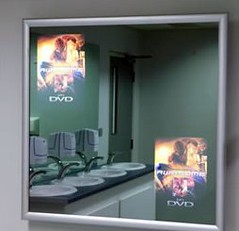
MediaSoon notes that UK ambient advertising company Addirect is selling a pretty cool-looking media system called Addmirror, which places backlit images behind a partial (2-way) mirror. When the backlight is turned off, the mirror looks completely normal. When the backlight turns on, the image suddenly appears. Multiple areas can be lit up at once, or you can cycle through different lit areas to show different images on different parts of the mirror.

I've seen similar digital signage systems before, (in fact one of our resellers wired up a bunch of high-end beauty salons with LCDs behind partial mirrors so that people could watch TV while getting a haircut), but there's something to be said for the simplicity of a static-image system like this.

Tags: retail media, ambient media, retail marketing, advertising

Thursday, November 16, 2006

Supervalu aims to surprise and delight shoppers

Fresh off of their recent acquisition of the Albertson's grocery chain, Supervalu CEO Jeff Noddle announced an ambitious plan to spend $1 billion in the coming years to remodel existing stores and build a few new ones under a new program called Premium Fresh & Healthy. The goal, according to Duncan Mac Naughton, EVP of Merchandising Marketing, "is all about surprising and delighting the customer," which will apparently include things like:

[expanding the stores'] produce, meat, seafood, bakery and deli departments. Stores remodeled or built under the new plan will also have an area for international foods, since 24 percent of Americans eat at least one ethnic meal a week, Mac Naughton said.

Supervalu is also pushing to focus on natural and organic products, which have become quite popular for mainstream grocers in the past few years after the rapid growth of specialty chains such as Whole Foods Market Inc.
While it certainly remains to be seen exactly how the chain expects to delight their shoppers, I'm hoping that they'll introduce some new innovations for making grocery shopping faster and more convenient (and you can always spot the good innovations because they spread through the whole industry like wildfire :)

Tags: digital signage, store experience, retail media, in-store media, merchandising, retail marketing, advertising, visual merchandising