Showing posts with label retail marketing. Show all posts

Thursday, January 08, 2009

Are you a cart puller?

No, not in the pack mule sense of the phrase, but rather in the "move down the checkout aisle pulling your shopping cart behind you" sense.  If so, you may be missing a big chunk of marketing messages trying to get you to make a few last impulse purchases before you pay.

That's what boutique market research firm Relevation Research concluded (and AdAge reports) after studying shoppers moving down the checkout aisle.  While "pullers" as they're called (and you can count me among them) account for about 74% of shoppers, remarkably most marketing materials and POP around the checkout aisle are designed for pushers -- those folks who push their cart down the checkout aisle (why they do that I'll never know.  But then, I'm a puller). The critical takeaway ias that, "The front of the store is a department, accounting for 1% of sales or more." That's according to Nan Martin, a co-founder of Relevation, who continued, "It's designed for consumers to make impulse purchases as they push through. If you're pulling, your back is to the merchandise most of that time."

I can see this kind of information putting retailers in a bind.  It's definitely not intuitive or "pretty" to have POP and other promotional materials face backward.  And while many displays are designed to be shopped from 360 degrees, few visual aides are designed to be seen from 360 degrees.  And if you decide to simply double up the number of ads in hopes of attracting the attention of both pushers and pullers, it's going to start looking very noisy, very quickly.

On the other hand, one must imagine that retailers are happier knowing what's going on than not, right?

Right?

Tags: ,

Saturday, May 24, 2008

Just a date or serial monogamy?: Loyalty programs in an economic downturn

Here's a follow-up to ongoing stories about consumer behavior during economic slowdowns (as a stress-reducer, I’ll still avoid using the R-word): The key question for retail sales right now is, of course, how to keep spending steady? Or, in other words, how do we know you love us if you don’t come back for more? Right now spending is unquestionably heading down and as those tax rebate checks begin rolling out, the necessities (food, gas, and love?) will come first. Surveys say we should expect to see people using that small boost to fulfill daily needs and bring down personal debt.

Some reports suggest that technology sales are still good: people continue to see televisions and cell phones in the category of "needs" rather than "luxuries" (and in a perfect world, my economic stimulus package would prove my love for Apple in the form of an iPhone). But aside from that, most analysts suggest that even adjusting for housing and car sales, personal consumption is shaky. As Mike Mandel of Business Week points out, it's also a bit hard to define:

What the government calls "personal consumption" is actually a grab bag of items, some of which don't really fit the usual notion of consumer spending. For example, the nation's current annual personal consumption of $10 trillion includes about $1.8 trillion in outlays by Medicare, Medicaid, and private health insurance providers... In fact, once medical outlays... are set aside, it turns out that the rest of personal spending has actually fallen since November, adjusted for inflation. The decline is pretty much across the board: inflation-adjusted purchases of food, clothing, furniture, and motor vehicles are all down. The part of health-care spending that individuals control most directly—prescription drugs—is down as well.
Although spending on clothing and household goods looks tight, Kohl's and Aeropostale posted some gains. But what are they doing that might make a difference? Kohl’s has a two-way romance going: one is a longstanding relationship with its credit card and frequent customers. The second is a flirtation with the regular crowd. The retail giant counts on a strong loyalty marketing program, with a pre-existing direct mail coupon and deeper discounts for credit card holders. At the same time, fliers offer regular deals for "walk-ins." Even teens are spending less, and their loyalty is like a high school crush: the retail love story with Aeropostale will probably be short lived. The clothing company didn't rate a mention in a recent list of "Top 15 Brands for Gen Y Trendsetters."

Where does that leave everyone else in the retail dating game? There’s no question that tempting consumers to spend will depend on incentives such as in-store deals, bargains, and coupons. It also doesn’t hurt if it’s a relationship with perks. Consider the success of grocery store loyalty programs that give regular customers money off at the gas pump for every dollar spent.

In general, loyalty programs might want to increase their flexibility at a time when customer relations are no longer like serial monogamy. Programs where consumers stop getting coupons if they don’t purchase on a regular basis will quickly lose viability. The concept of "unprofitable loyalty" may be worth revisiting so that regulars get more incentives but infrequent customers still feel as though there might be a better bargain in returning rather than seeking out a competitor.


Tags: , ,

Saturday, February 23, 2008

Consumers pay more attention to circulars than other advertising

Two reports highlight the growing importance of in-store marketing. The first (noted by Progressive Grocer) was released by Vertis Communications two weeks ago and noted that, "47 percent of Americans cited inserts and circulars as the most effective, a 9 percent increase since 2003. Also according to the report, inserts and circulars have surpassed TV advertising as the medium most able to draw consumer attention." Further, "Forty-three percent of those surveyed said TV advertising interested them the most, but that was a 10 percent decline from five years ago. Meanwhile, 38 percent of respondents thought newspaper advertising best grabbed their attention, down from 45 percent in 2003."

Helping to confirm those results are new findings from BIGresearch that also point to the increasing importance of marketing at retail. Across all demographic groups, 27.4% of those surveyed said in-store promotions influenced their decisions, up 0.5% from last year. That compares favorably to TV/Broadcast at 27.9%, though still ranks behind traditional forms of retail promotion like newspaper inserts (30.5%) and word of moutn (42.6%). Of course, the influence of newspaper inserts have also been falling steadily the last few years, and plunged -4.5% last year lone (the influence of word of mouth promotion remained steady).

Tags: ,

Monday, December 17, 2007

Retail stores try to stay relevant/compelling for web-savvy shoppers

Over at BusinessWeek they've taken a very comprehensive look at how the increasing amount of web-savvy shoppers is affecting the retail industry. They conclude that the big change in shopping behavior boils down to a lack of patience on the part of this new type of shopper. For example, if a customer can't find what she wants at a store or has trouble getting information about that product from store reps then she'll simply go online. This is obviously dangerous for bricks-and-mortar shops, since a customer shopping at Best Buy who leaves because she couldn't find what she wanted, won't necessarily make her purchase from BestBuy.com. She could just as easily go to Amazon, and Best Buy would have lost a costumer because their in-store experience was not up to snuff with the web (despite the store being much more costly to maintain).

This should be a wake up call for retail stores, especially during the biggest shopping season. The increasing power of the web must make retail outlets more prepared to serve customers if they want to remain relevant. The clichéd model of the pimple-faced teen with no product knowledge working behind the counter simply isn't going to cut it anymore. The store's power still lies in being able to provide personalized experiences and information to customers, and if somebody is shopping in-store they're basically saying they value that. They don't want to be bothered by no-nothing idiots. They want a very friendly and knowledgeable human being to assist them. No more jaded sales employees. If customers don't require (or don't value) that level of interaction, they're more likely to stay at home and do their shopping online.

The article also discusses how Best Buy in particular is putting its employees through a much more rigorous training process which hopefully makes them better prepared to answer customer questions and provide more informed recommendations, as Bill noted two weeks ago. Best Buy's chief competitor, Circuit City, has also made it much easier for customers to order online and then pick up their purchase in the store, which makes for an effective integration between their web and retail shopping experience. So it's obvious they're paying attention to what's happening and trying to react. In-store pickup is a good example of using the web's wide net to funnel people into the bricks-and-mortar store, and has the potential to become the cornerstone of many multichannel marketing approaches in the future. But Best Buy gets my applause for understanding why people still shop in stores -- it's the people and the experience. And that's what they're trying to focus on and improve now.

Tags: ,

Monday, December 03, 2007

Best Buy to wow customers this holiday, but the right way?

On the one hand, this press release from electronics retailer Best Buy detailing the results of their annual holiday survey seems to make plenty of sense. Faced with making a big-ticket electronics purchase, the vast majority of survey respondents indicated that a good return policy, attentive phone service and lots of customer assistance available on the sales floor would be the most useful changes that Best Buy could make this season. So, not surprisingly, these are the areas that Best Buy has been focusing on. They've extended their return policy for holiday purchases through January 31st. They've converted a third of their sales floor staff to "Customer Assistants" who will hopefully provide knowledgeable, reassuring service to bewildered buyers. And they enhanced their phone support options by letting callers connect to live store operators that can consult on purchases, check product inventory, etc. These are all good things, right? Surely they'll impact the firm's bottom line (in a good way) while improving the in-store experience, right?

Well, maybe not. At least not necessarily if you believe what the Integer Group found (according to this AdAge article) recently when it came to making consumer electronics purchases. Specifically:
[A]mong all shoppers, almost one-third bought electronics based on an offer or promotion, the most popular being rebates and sale prices. Also, most of the buyers (75%) browsed on the web before purchasing. Shoppers went online an average of more than three times to do research before buying, and it was "not uncommon" for the shoppers to make 10 or more internet visits.

...However, even more important are effective in-store displays. When the buyers in the survey rated the in-store displays as effective, their purchase satisfaction went up by almost 300%.
So essentially what Best Buy's survey found to be important doesn't seem to jive with what Integer's survey found to be important when making a sale. Normally I'd say that improving the in-store experience and driving sales aren't mutually exclusive goals, with the former often driving the latter. But these results are pretty weird. The availability of trained sales staff on the floor did little to promote sales, whereas it was #1 on the list of things customers hoped to see from a new and improved Best Buy performance. On the other hand, nobody in the Best Buy survey was clamoring for new or better POP displays. Nor did they mention they wanted lower prices or better promotions (though that was probably due to the way the survey questions were presented). Yet Integer's survey indicated that these devices were best at driving sales.

So who's right here? Are people assigning some mental value to items on a survey page that don't translate in the real world? Or is it simply futile to try and compare the results of two different surveys, one trying to improve customer satisfaction and the other trying to understand the sales process and key triggers?

Tags: ,

Monday, November 05, 2007

A two-step test for adding new in-store marketing systems

Actually, the way George Anderson, the article's author pitches it, perhaps the question is "which is the right approach?" It seems that with the proliferation of new retail media, and the newfound acceptance these strategies have found, execs have started to decide that the question is no longer whether to advance an in-store marketing strategy, but rather which strategy they should choose. (Indeed this was the crux of an argument put forward by Marc Babej and Tim Pollak from Reason Inc. in a recent Forbes commentary article).


Getting back to the RetailWire article, though, Anderson asks two questions: first, are shopping carts offer potentially valuable media space, and second, where are the best opportunities in terms of technology for retailers and marketers to influence consumer purchases with shopping carts?

As is often the case with a RetailWire BrainTrust article, there are dozens of comments posted beneath the article, many of which are pretty insightful. A lot of them are also target-specific, focusing on the potential benefits and drawbacks of advertising on shopping carts (my two cents: a nice, but not killer, idea for static ads; digital stuff will never work). But the better comments dive into a theme that I've noticed becoming more common in recent months, especially as retail digital signage systems have really taken off.

Specifically, people tend to get wrapped up in one particular medium or message conveyance method, instead of looking at the entire store as a cooperative system. Even professional marketers with years of experience have been known to get easily distracted by the new/cool/shiny thing, and deploy it without thinking of whether it makes the whole environment any better. So here's my wholly-anecdotal, two-second test for guessing whether a new form of in-store media is going to be a positive or negative addition to your environment:

1. Does it put the message on the same shelf as the product? Retail media is local, and I mean really local media. You have two or three seconds to impart your message at best, and then maybe 5-7 seconds of retention after that. So if your message isn't within 10 seconds of the product, its value starts to decline rapidly. The solution: keep messages as close to the product as possible, and understand that the further away you move them, the less good they'll do.

2. Does it compete with or complement other nearby media like POP displays, posters and endcap setups? Walk into a supermarket and you're bombarded by messages, and that new snazzy addition is going to quickly become part of the background noise if it has to compete with messages for similar products (or even different messages for the same product!), and other clutter nearby. The solution? Get rid of all other forms of in-store marketing. Just kidding. Since that's obviously not viable, the real solution is to create integrated campaigns. If Keebler will be advertising 3 different products in your store this month, the ads for each should play off of each other. If colors need to be different, then shapes should be the same. The logos should be similarly positioned, and so on. If the campaign will feature floor-standing displays and spots on digital signs, they should look similar to each other. That way, even if one part of the message is displayed far away from the product, the customer will be primed when she encounters the other component that is nearby.

If your can't answer "yes" to both questions above, then you may want to give a bit more thought to your new media approach before deploying it to your stores, since chances are that it will not perform as expected.

Tags: ,

Monday, October 22, 2007

High-tech carts inform shoppers of unhealthy choices

ABC News reports that shoppers London may soon have access to trolleys (that's shopping carts for us Yanks) that can warn us when we are buying too much unhealthy food at the supermarket. According to the article, "the high-tech model will be fitted with a computer screen and barcode scanner. It will read each product's individual code to give customers information about calories, nutrition, ethical sourcing and the environment."

This is definitely an interesting concept, though it seems there may be more drawbacks than benefits. There are thousands of products in any supermarket that are not healthy (in fact I wouldn't be surprised if the unhealthy ones outnumber the healthy ones). So how will the folks at Frito Lay, Coca-Cola, etc. feel about a machine attached to a cart that essentially tells shoppers not to buy their product? I think it's safe to say that they won't be making any contributions to EDS, the U.S. based company responsible for the technology any time soon (unless said contributions would help to reclassify what things are "healthy.") I also wouldn't be surprised to see some vendors lash out at supermarkets using the tech, since it will essentially be negating all of their product advertising and in-store promotions.

In the end, this kind of technology is probably better suited to high-end markets and specialized health food stores where people are making the conscious decision to eat an entirely healthy diet, and will be interested enough in what they're buying to stop and read the text on the screen for a minute or two. In such places it would be easy to tout the technology as a new service to provide even more information to consumers facing an increasing number of choices (especially in said high-end places where you're buying "lifestyle" as much as anything else). In mainstream supermarkets, though, I think it can only hurt business as a whole, and worse, it could pit the retailers against some of their biggest vendors.

Tags: shopping cart, smart cart, retail marketing

Wednesday, October 17, 2007

RetailWire asks: is the "seamless" store experience important?

There's another interesting conversation going on over at RetailWire, this time about how important it is (or will be) for retailers to provide a seamless transition between their brick-and-mortar and online properties. As RetailWire's editor George Anderson notes, "consumers can order a product online and pick it up in a store. They can order an item online at a kiosk located in a store. Today, retailers are looking for ways to integrate the virtual and brick and mortar shopping worlds to better serve consumers' needs and drive sales in the process." Of course, such integration comes at a price, and many have wondered what (if any) benefit there is to making it work.

Well, specifically they wonder about the benefit to the retailer, since the benefits to customers are obvious (better service, more options, etc.). And while some might argue that anything that benefits the customer is sure to benefit the retailer in the long run, the cost of making services like pick-up-at-the-store and product line extension kiosk networks can be large, and the logistical challenges associated with such projects are ongoing.

Even with that argument in play, though, it seems like retailers will eventually have to do whatever they can to make sure that their real and virtual presences are compatible, and ideally, completely integrated. To whit, here's the comment I left at RetailWire using Barnes & Noble (one of the companies actually doing something -- finally -- about linking their website and retail stores together):

I really like going to bookstores and trying out the merchandise before purchasing. However, if I can't find a book on the shelf, or an associate helps me to determine that it's out of stock, my choices are to either go to another store or have the book shipped (to the store or directly to me). I'm lazy, so in most cases the former isn't a viable option. As for the latter though, if the store *doesn't* have an easy way to order and ship it to me, I'll just go home and buy the item from Amazon, since either way I have to wait for it. Worse, I might just pull out my web-enabled phone and make the purchase from another vendor while I'm still in the store. Only by making access to inventory and alternative purchase processes as simple as possible does the brick-and-mortar retailer have any hope of securing that sale from me.

While I might be atypical in this regard right now (though I doubt it), I certainly won't be in the not-too-distant future.

Tags: , , ,

Tuesday, September 25, 2007

Nielsen and POPAI work out in-store media effectiveness

BrandWeek reports that sometime this week Nielsen Co. will make a major announcement regarding its effort to track the effectiveness of in-store marketing. This comes at more or less the same time as POPAI, the global organization for marketing at retail, plans to unveil their own study of the market which involved, "a proof-of-concept study of 400 shoppers who journeyed through four retail outlets-- 7-Eleven, BP, Dominick's and Walgreens--that explores the issue of engagement within the retail environment.POPAI's Marketing at Retail Initiative outfitted those consumers with micro-cameras to track their interaction with retail display materials."

POPAI examined several metrics including an impact ratio, which "measures in percentage the number of shoppers who passed the display and saw it", and an effectiveness ratio that, "describes (also in percentages) the number who passed the display. For example, if 10 shoppers pass a display, it gets a 100% effectiveness ratio score. If 10 pass it and three see it, it gets a 30% impact ratio score."

While I understand the difficulty of tracking shoppers as they walk the store, I really hope that one of these two groups will eventually come up with something better than outfitting shoppers with cameras. Even if shoppers get used to the devices, it still seems like a shopper wearing the device will behave differently than one without. If you knew your actions were being caught on camera, even if your face wasn't showing, would you pick up that box of condoms? What about anti-fungal medication? What about dandruff shampoo? Causing a shopper to stop and think instead of simply follow his or her list makes for unnatural behavior and consequently less accurate measurements.

Despite all of the technological gadgetry being used, it still seems like retail outlets could get much better data for the effectiveness of in-store marketing by running split-tests and comparing sales results. For example, take a chain store like Wal-Mart. If they install more aggressive in-store marketing for a particular product in one store but not in another, they could then compare sales in order to determine the effectiveness.

As usual, we come back to trying to figure out what "effective" means. For example, just because people pass by a display and see it, it can't automatically be called effective or ineffective. What matters the most to retailers and advertisers is whether or not noticing the ad spurred shoppers to make a purchase. What the POPAI study seems to measure more accurately is how attractive or eye-catching an ad may be, rather than how effective it will be at producing more sales. In theory, if the POPAI study was adopted as the industry standard, advertisers could just fire off ads full of bright colors and catchy visuals and as long as shoppers looked at them they could conclude they were effective and therefore charge more money. But where does the value for content come into play? An ad with less striking content may not attract as many eyeballs, but those that do notice it may be more likely to make a purchase based on its offer.

Tags: Nielsen, POPAI, retail marketing, in-store marketing

Monday, August 20, 2007

Retailers remember: if we look good, you look good

Sara Cantor, the Curious Shopper herself, has once again reminded me that I'll never really understand the way girls think. Specifically, it was this article that did it. Don't get me wrong -- with all of her usual flare for storytelling, Sara delivers some great shopping-related insights that have real, practical implications. But darn it, as much as I try, try, try to understand what people do in store, there are tidbits like this that I would just never think of:
If you want girls to buy your prom dresses, don't make them try them on in their white gym socks. Give them heels, for god's sake. They will look ten times better, and will be more likely to buy the dress. Who knows - they might even buy the shoes too.
What a nice cross-sell opportunity, and it apparently solves a problem that I never even knew existed. Granted the body of Sara's argument, namely that people will spend more when they look/feel better, is a much more well recognized and understood concept nowadays. In fact, retail anthropologist Paco Underhill has written entire chapters on how bad most dressing rooms are, and how many more sales would be completed if retailers would just spend a little money to make them look better (and by extension, make their customers look better, too).

But still, I'm apparently not spending enough time in stores really watching how other people shop. Case in point? Sara's own anecdote about buying glasses. This should be something I can relate to, I just bought a pair myself recently. And in fact, I went to three different places (long story, not too interesting though), and observed no fewer than a dozen other people shopping for specs too. Yes, everyone was looking in mirrors, and most tried on a number of pairs before settling on the right ones. But I didn't observe the ritual Sara describes. Apparently either that was too time-consuming for my audience, or maybe we just didn't have the same dedication to the task.

Or, after reading through my notes once again, maybe there's another reason: the dozen folks I saw shopping for glasses? As it turns out, they were all guys.

Tags: ,

Customers want the "in-store experience" to continue online

Lots of people have spent an unhealthy amount of time writing about the importance of the retail experience -- the environment, the products, the thrill of the hunt -- whatever it is that turns an average shopping outing into something a bit more unique, personalized and fun. In fact, shopping is increasingly become a pass time for many who will spend hours going from store to store even when they have no plans to purchase anything (so I'm told -- the concept is pretty foreign to me personally). But I was pretty surprised to find that online shoppers are starting to expect the same kind of "shoppers high" on the web as they do in brick-and-mortar stores. And as this article from the Retail Bulletin notes, with fickle shoppers easily able to bounce from one virtual store to the next, that's causing a lot of sleepless nights for the e-commerce gurus working behind the scenes at many of the most famous retail chains:
Customers demand an experience that is functional and easy to use. Tickbox.co.uk recently found that 90 per cent of users would happily switch to a competitor if a site fails to load. However, they also want to feel genuinely welcomed and see strong continuation of the brand they know and love. A visit to your web site should only further encourage the loyalty that your customers feel for you. As such, it should be remembered that online storefronts are now an integral part of the business for any retailer, and need to present themselves as much more than just an online catalogue of products. Every website needs to reflect the same brand values and aesthetics as your other customer touch-points, be it in store, via email or through your call centre.
With evidently such little brand loyalty, many retailers are turning to multi-channel programs that mix online loyalty features with calls to the brick-and-mortar stores where it's easier to stand apart from competition (and the competition is literally harder to get to than online). The article recommends using a web-based presence not just as a product catalog, but instead as a sales tool designed to provide a personalized brand experience, thus moving the traditional in-store experience into the shopper's home. The web can also be used to drive traffic to slower moving lines that might fit particularly well with the shopper's tastes depending on information collected as part of the aforementioned loyalty program. In the end, the article states, retail stores are still the best place to follow the 80/20 rule of sales (where 80% of sales are generated on the top 20% of products), but with the web there's now a cost-effective way to tap the "long tail" effect by connecting customers with ideal, though harder to find, products.


Tags: ,

Friday, May 25, 2007

Nike and Foot Locker partner for new retail experience


DDI has a short blurb on a new partnership between Nike and Foot Locker to bring about a new type of retail store. Dubbed the "House of Hoops by Foot Locker," the pair expect to open 50 of these themed stores over the next three years to, "create a new brand- and community-oriented retail experience celebrating the culture of the game for basketball consumers."

While Nike and FootLocker have used this theme for store-within-a-store displays before (as in the above image), a self-contained store to brand and promote the culture of basketball is a new direction for both companies.

Considering how hard Nike has tried to correlate their brand and brand image with the overall notion of sports and activity, I think this marks a natural next step for the company. By strategically placing these stores in areas with a high density of people who don't just play basketball but feature it prominently in their worlds (I'm guessing mostly urban areas), Nike has the opportunity to not only pick up some incremental sales, but further establish themselves as the "official" brand of basketball. Not a particular player, or a given team, or even the whole NBA, but the very sport itself.

Will it work? I'm on the fence here. While Nike has proven to be quite nimble and great at both identifying and establishing trends, the urban market is notoriously fickle and anti-establishment, so that will be a tall order.

Tags: Nike, House of Hoops, retail marketing

Saturday, February 17, 2007

Should the pre-shopping phenomenon affect retail marketing plans?

Over at RetailWire Alan McClain did a nice writeup of a presentation by Deloitte & Touche's Pat Conroy did at the NRF this year. The most interesting piece of the whole thing:

A key finding of the survey was that 66 percent of store visits this holiday season were not influenced by advertising and marketing. Mr. Conroy said this is consistent with previous studies and shows that, to win shoppers, retailers need to deliver consistent shopping experiences and fulfill brand promises. In other words, previous shopping experiences are more important than advertising messages.
Apparently, in an effort to save time and make shopping more efficient, more people are engaging in so-called pre-shopping techniques, like searching for a product or store information online before actually visiting the store. In fact, 61% if those surveyed by Deloitte did this kind of thing, which obviously means that push-based advertising and marketing takes a back seat to research (to some extent) in these cases.

The point that McClain raises at the end of this is whether retailers would be willing to take some portion of their traditional advertising budget and spend it more on cultivating customer relationships and improving the in-store experience. Obviously most retailers are hesitant to make "cuts" in t heir marketing budgets, but I think in this case most would need to be convinced that it would be more of a reordering of marketing priorities, and re-purposing of funds, maybe even by adding some portion of the new customer service and CRM initiatives into the marketing budget.

We've heard lots of stories before about shopping being an experience, a destination or a pastime. But the research presented by Deloitte suggests that some times, a shopping trip is more like a job or a task, where some analytical research at the beginning of the process can yield better results (in terms of total time and money spent), without much of an emotional appeal during the pre-shopping process (which, since it limits the amount of "actual" shopping time, also reduces the emotional component of the shopping trip itself).

I'm still of the opinion that most shopping trips can be broken down into one of these two categories (e.g. either "pastime" or "task"), however it also seems likely that elements of one can seep into the other. For example, shopping for a high-def TV, something that can only really be considered a non-essential luxury item, is going to have some emotional toll. Shoppers will visit one or more stores not just to look at different screens and check prices, but also to pick the brains of store employees, check out any necessary accessories, etc. Considering how big of a purchase it is, though, those same people will go home and do research on line, looking at customer reviews and competitor pricing before making a purchase decision. In this case, the "shopping" portion of the purchase process is still largely experience-driven. The "buying" portion, however, is more analytical in nature, and is thus more prone to the effects of pre-shopping (and maybe even post-shopping) research.

Tags: retail media, in-store experience, shopping, retail marketing

Thursday, January 04, 2007

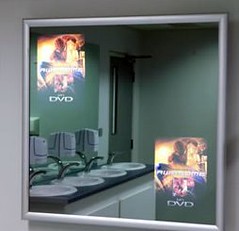
AddMirror brings retail media to the narcissist

MediaSoon notes that UK ambient advertising company Addirect is selling a pretty cool-looking media system called Addmirror, which places backlit images behind a partial (2-way) mirror. When the backlight is turned off, the mirror looks completely normal. When the backlight turns on, the image suddenly appears. Multiple areas can be lit up at once, or you can cycle through different lit areas to show different images on different parts of the mirror.

I've seen similar digital signage systems before, (in fact one of our resellers wired up a bunch of high-end beauty salons with LCDs behind partial mirrors so that people could watch TV while getting a haircut), but there's something to be said for the simplicity of a static-image system like this.

Tags: retail media, ambient media, retail marketing, advertising

Thursday, November 16, 2006

Supervalu aims to surprise and delight shoppers

Fresh off of their recent acquisition of the Albertson's grocery chain, Supervalu CEO Jeff Noddle announced an ambitious plan to spend $1 billion in the coming years to remodel existing stores and build a few new ones under a new program called Premium Fresh & Healthy. The goal, according to Duncan Mac Naughton, EVP of Merchandising Marketing, "is all about surprising and delighting the customer," which will apparently include things like:

[expanding the stores'] produce, meat, seafood, bakery and deli departments. Stores remodeled or built under the new plan will also have an area for international foods, since 24 percent of Americans eat at least one ethnic meal a week, Mac Naughton said.

Supervalu is also pushing to focus on natural and organic products, which have become quite popular for mainstream grocers in the past few years after the rapid growth of specialty chains such as Whole Foods Market Inc.
While it certainly remains to be seen exactly how the chain expects to delight their shoppers, I'm hoping that they'll introduce some new innovations for making grocery shopping faster and more convenient (and you can always spot the good innovations because they spread through the whole industry like wildfire :)

Tags: digital signage, store experience, retail media, in-store media, merchandising, retail marketing, advertising, visual merchandising