
Once again, the folks at RetailWire are having another lively discussion about the future of in-store media. Retail media expert Laura Davis-Taylor leads this BrainTrust Query (free registration required) in an attempt to answer the question of whether digitally-based retail media networks need a unique team and/or skills to function and be utilized to their fullest extent. As usual, the discussion is quite good, and there are responses on both sides of the table. My favorite is from Mark Lilien, a consultant with Retail Technology Group, who argues in favor of a interdisciplinary team by noting that, "retailing technology success is often 1% strategy and 99% execution."
That's a hugely important (and accurate) thought that still isn't well understood by many struggling to implement their retail media programs. The work that goes into up-front strategy is quickly surpassed by the work needed to implement and subsequently maintain any form of retail digital media, whether it be audio, video or interactive. Just because a medium is digital doesn't mean that it can lose it's relevancy or timeliness. Likewise, marketers would be wise to listen to the opinions of their customers during a retail media pilot, and consider making adjustments accordingly.
By my totally unscientific estimate, I believe that most retail media networks (digital signage in particular) are probably only utilized at 75% or less of their maximum efficiency (however one might measure that), since almost every network that I've looked at could benefit from some sort of improvement or other. Still, there are many who believe that once a network is deployed, it's finished, and the rest is up to the content guys. While that mentality might allow some networks to stay successful over time, there's almost always something that could be done to make it a little better for the consumer, and better performing for the retailer.
Tags: retail media, digital signage, in-store media, in-store advertising

Monday, January 15, 2007
RetailWire discusses the potential of in-store advertising

Friday, January 12, 2007
Just say No to Interruption Marketing
With all of the hoopla surrounding the recent rise of in-store media like digital signage and retail audio networks, it can be easy to forget that for every cool, innovative and successful projects there are any number that not only don't meet their objectives, but also go one step further and irritate shoppers. For all those projects, David Meerman Scott has started an Interruption Marketing Hall of Shame at Web Ink Now. A frequent traveler, David's top three inductees are all related to airports. For example, look at what he has to say about his #2 pick, CNN, for their CNN Airport Network:
CNN has created this crap so they make the Hall of Shame. I actually like CNN, but only when I choose to watch it (usually while I am on my exercise machine at home). I don't want to watch (listen) all the time. CNN should have a clause in the contracts that they write with airports for the CNN Airport Network that says that quiet areas must be made available in every terminal that installs their network. Listen up CNN: You are hurting your brand with this nonsense.Pretty strong words (I don't particularly mind CNN Airport Network myself), but there certainly are cases where less would have been more, and an otherwise good marketing opportunity becomes an annoyance. For example, #4 on David's list, Simon Property Group, is an example that I agree with. When Simon and Publicis Group announced that they were creating a digital signage network to be featured in malls, we all wondered what form it might take. After witnessing it first hand this holiday season, I must say I'm underwhelmed. In order to compete for attention over the cacaphony, the in-concourse screens blare audio that often just smashes up against audio coming from the different mall stores. In the food court, the screens are poorly placed (in the malls I visited, at least), and while not particularly loud or obnoxious compared to the already deafening noise that food courts are known for during peak traffic times, I can only imagine that when it's quieter they would be.
Retail marketing should not be interruption marketing. Retail media networks should complement the store environment, not stand apart from it in an attempt to be seen and heard. I think this is one of the biggest mistakes still being made in the retail media space today, and it's the reason why so many are still wary of using these systems in store.
Tags: retail media, in-store media, advertising, digital signage
Friday, January 05, 2007
A gift for germophobes: a shopping cart disinfectant system

Now, though, I've learned that's not enough, since according to this article at Storefront Backtalk, shopping carts at such places, "are never clean. They are covered in meat and poultry juices, a leaky toddler’s diaper and other germs." The solution, you ask? Well, Jim Kratowicz, president of PureCart Systems LLC (and provider of that quote), suggests his PureCart system, which uses a hydrogen peroxide-based solution to reportedly kill 99.99% of bacteria and more than 90% of viruses.
Tags: shopping carts, PureCart Systems
Thursday, January 04, 2007
Looking for RFID ROI
There's a nice thread on RetailWire about the ups and downs of RFID, which was once heralded as the greatest thing since the barcode, but is currently still looking for a place to truly shine. As Chantal Polsonetti, VP of Manufacturing Advisory Services for Arc Advisory Group notes, many manufacturers don't expect massive supply chain benefits by implementing RFID systems, and instead are looking for secondary benefits to drive ROI:
"Our manufacturing customer base is telling us they already have sophisticated supply chains, so the benefit from RFID in the distribution center is incremental at best," she told Modern Materials Handling. "Instead, they're looking at applications around asset tracking, work-in-process and how product moves through the retail store to get an ROI."
Back-office applications still seem like the best fit for RFID, though there are certainly numerous applications that could benefit from the extra awareness that an integrated RFID system brings, and NCR has suggested some ways that RFID could be used to improve the in-store experience. Still, until consumer trust in the technology improves and certain security issues are resolved, I expect that RFID will continue to have more to do with tracking boxes in a warehouse than helping a shopper locate products in store.
AddMirror brings retail media to the narcissist
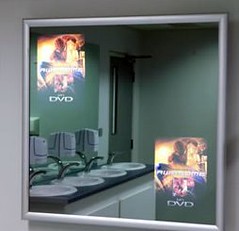
I've seen similar digital signage systems before, (in fact one of our resellers wired up a bunch of high-end beauty salons with LCDs behind partial mirrors so that people could watch TV while getting a haircut), but there's something to be said for the simplicity of a static-image system like this.
Tags: retail media, ambient media, retail marketing, advertising
Thursday, December 14, 2006
Could Google bring user-created content into retail stores?
A few months ago I speculated that Google and YouTube could team up to deliver low-cost content to the thousands of digital sign networks out there that can't afford full-time custom content creation. Just yesterday there was an interesting article about automatic video tagging that I blogged about at Digital Signage News, in fact, that added to this speculation.
Today, it seems, would be a good day to add even more fuel to the fire, in the form of two ads about real companies utilizing low-budget content, and another about Google's foray into radio advertising. First is this article from AdvertisingAge about Dove solicing ads from consumers. AdAge notes:
In an e-mail today to members of its online relationship-marketing program, Dove began seeking entries for a 30-second ad to promote a new product, Dove Cream Oil Body Wash.The second article is from arch-rival AdWeek, and focuses on Southwest Airlines, who is also asking for user-generated content to incorporate into its TV advertising campaign. Southwest is actually partnering with YouTube to collect 20 user-submitted embarrasing situations to include in its "Wanna Get Away" campaign. And in fact AdWeek notes a few other examples where name-brand CPGs have experimented with user-generated content:
The e-mail directs people to DoveCreamOil.com, a site hosted on Time Warner's AOL, which provides online tools, artwork, photos and music for creating ads, and also allows consumers to upload their own files. "You don't need any special skills or experience," the e-mail says.
Doritos is currently running a contest with Yahoo that will air a user-submitted video during the Super Bowl. Chevrolet, Sony and Converse are also experimenting with the concept.And how would a hypothetical GooTube or Tooble get all of this great content from the Internet to a bunch of in-store displays without a lot of administrator intervention? Well, that's where this last article from ClickZ comes in. Google is finally putting its acquisition of dMarc to good use, and allowing a current pool of 700 radio stations to subscribe to its AdWords-like service for radio. The article states:
A Chevy Tahoe promotion that let consumers create their own executions pointed to the risks of the tactic. Environmentally minded users created several ads lambasting the SUV for its effect on the environment.
Google Audio Ads are sold on a CPM basis through the AdWords platform, and advertisers can target on factors like geographical market and time of day. Reporting functions disclose which stations ran ads and when, and real-time air checks are available, a bit of a novelty for interactive marketers who have grown used to not seeing their non-search executions.The retail media market is still to immature for Google to put a lot of effort behind it, but it's certainly coming, and with brands getting on board behind user-created content (and the ongoing march of progress over at Google), I'm willing to bet that within a few years there will be little distinction between how Google and others supply Internet, radio, TV and retail media spots and fill out inventory.
One last (and quick) update: No sooner had I published this post than I came across David Polinchock's post about Martin Sorrell's take on Google (he calls them the "frienemy"). Great article, go check it out, and read the other article that he references about Google and ad agencies.
Tags: Google, YouTube, dMarc, digital signage, retail media, out-of-home advertising
Tuesday, December 05, 2006
VNU To Develop In-Store Measurement Service
After creating quite the commotion about it's P.R.I.S.M store media measurement technique, VNU has decided to take the service live, doing what it calls the "lead-market phase" of the new service in early 2007, with full availability later in the year. From the press release:
The new service, which will be developed through a new unit of VNU known as Nielsen In-Store, will measure consumer exposure to a fast-growing and powerful array of in-store marketing vehicles, including television and radio, shelf talkers, digital signage, and other point-of-purchase displays. Collectively, these in-store marketing approaches stand as the sixth largest advertising vehicle in the U.S., at $18.6 billion in spending in 2005.The same big names featured in the pilot project are endorsing the full-scale system, suggesting that early results were good. Members of the consortium include 3M, Coca-Cola, Kellogg’s, Miller Brewing, Procter & Gamble and The Walt Disney Company, as well as major retailers like Albertsons, Kroger, Walgreens and Wal-Mart.
The new service will also help retailers improve results through better store layouts, category adjacencies and product selection. “The new information we provide for retailers and manufacturers will help them work more effectively to improve the shopping experience for consumers,” said George Wishart, who has been named global managing director of Nielsen In-Store. “We also will provide the advertising, media and retail industries with a new currency standard that can increase the efficiency of the media buying and selling process.”
(Cross-posted at the digital signage news blog)
Tags: VNU, P.R.I.S.M, retail media, media measurement, in-store advertising
Thursday, November 30, 2006
Wal-Mart names Roces to head ‘Store Experience’
Home Textiles has a brief blurb about the appointment:
Wal-Mart Stores is creating a new organization it calls “Store Experience” to delve more deeply into store planning, space management, and the retailer’s store-of-the-community initiative.Tags: Wal-Mart, store experience
Santiago Roces, who was most recently Wal-Mart’s Korea president, will be leading the initiative. He is relocating to company headquarters in Bentonville, Ark. Roces’ promotion is one of several appointments that make up Wal-Mart’s recently restructured marketing “dream team,” explained John Fleming, evp and chief marketing officer, during Wal-Mart’s presentation Wednesday at the Morgan Stanley Global Consumer & Retail conference here.
Luxury auto dealerships invest in good design
While consumer retail garners the most attention when it comes to in-store media, a lot is going on in the retail automotive sector that deserves some commentary as well. My company has been working in that space for about four years now, installing both interactive kiosks and digital signs into hundreds of US dealers, and big chains like AutoNation have also invested in chain-wide digital media networks.
USA Today apparently noticed the trend, as they published this article about the lengths that luxury retail auto dealers are going to in order to bring their dealerships up to snuff. They note:
At Fletcher Jones Motorcars, customers stroll through a gallery of Mercedes-Benzes, linger at the cappuccino bar, tap balls on the putting green or go for a pedicure.A couple of blocks away, Newport Lexus boasts marble fireplaces, Oakley and Tommy Bahama beachwear boutiques — and a flat-screen television, tuned to ESPN, of course, mounted above the urinal in the men's room.
The two dealerships are pouring on the fancy fixtures and service extras as they vie for a larger share of one of the nation's most prosperous luxury-car markets, coastal Orange County. But even far from "The O.C.," auto industry officials see the sprucing up of luxury-car dealers as a sign that the high-end market could finally be brightening.
I don't know if I'd particulary want a pedicure from my auto dealer, but it's certainly interesting to see that retail design is being used as a gauge for market performance.
Tags: retail automotive, auto dealerships, retail design, store design
Uniqlo injects Eastern design into western retail

While spartan layouts and stylish fixtures have long been present in tiny boutiques and haute couture specialty retailers, Uniqlo is trying to blend their casually trendy offerings with a high style, dare I say upscale retail design that oozes with simplicity and orderliness. From what I've seen, I certainly think they've met their design goals.
Tags: Uniqlo, retail design, store design
Making an emotional appeal with in-store media
Note: I've cross-posted this to the Digital Signage News blog, since the subscriberships seem to be somewhat different (and unrelated).
Institutions spend too much time focusing on the science of shopping, rather than the art of shopping. So says The Integer Group's Meg Kinney in her article "The Art of Shopping," featured in the November/December issue of HUB Magazine. While that sentence might not appear to make a lot of sense on the surface (since when is shopping an art or a science, anyhow?), Kinney looks at the growing number of retailers who are focusing on ways to enhance the in-store experience, and comes to some interesting conclusions about what needs to be done to bring in-store media up to snuff in today's experiential retail environment.... Read the full article: Making an emotional appeal with in-store media
Tags: in-store media, at-retail media, digital signage, out-of-home advertising,
Thursday, November 16, 2006
Supervalu aims to surprise and delight shoppers
Fresh off of their recent acquisition of the Albertson's grocery chain, Supervalu CEO Jeff Noddle announced an ambitious plan to spend $1 billion in the coming years to remodel existing stores and build a few new ones under a new program called Premium Fresh & Healthy. The goal, according to Duncan Mac Naughton, EVP of Merchandising Marketing, "is all about surprising and delighting the customer," which will apparently include things like:
[expanding the stores'] produce, meat, seafood, bakery and deli departments. Stores remodeled or built under the new plan will also have an area for international foods, since 24 percent of Americans eat at least one ethnic meal a week, Mac Naughton said.While it certainly remains to be seen exactly how the chain expects to delight their shoppers, I'm hoping that they'll introduce some new innovations for making grocery shopping faster and more convenient (and you can always spot the good innovations because they spread through the whole industry like wildfire :)
Supervalu is also pushing to focus on natural and organic products, which have become quite popular for mainstream grocers in the past few years after the rapid growth of specialty chains such as Whole Foods Market Inc.
Tags: digital signage, store experience, retail media, in-store media, merchandising, retail marketing, advertising, visual merchandising
Tuesday, November 14, 2006
Inside retail stores, it's all about the 'message'
I don't like stealing other people's titles when summarizing an article, but this article from the Pittsburgh Post-Gazette really hit the nail on the head. You don't normally see a lot about retail media or the retail experience in mainstream newspapers, but clearly there's a lot going on in-store, and with the holiday season nearly upon us (or already upon us for a few weeks, if you're some retailers), perhaps some people are starting to take notice of their shopping environments. The article notes:
Every retail space has to handle merchandise shifts. At the beginning of a season, racks of hanging clothes may be full. As they empty, the walls might adapt to hold shelves or make the most of a shirt on a hanger. Color choices in carpet and paint can't clash with the latest fashions. "Flexibility is really important in retail," said [Suzan Lami, of Lami Grubb Architects]. Architects hoping to create something for posterity should be aware that in retail, change is not just embraced, it's required. Some of Ms. Lami's clients' leases require their stores be remodeled every five years, whether the existing design was a good one or not.Consumers are more fickle and ad-shy than ever, and with the echo boomer generation coming into their own as an educated, mobile and media-savvy consumer demographic, stores are having an increasingly hard time combating poor advertising performance and Internet shopping options. By making the in-store experience more interesting and enjoyable, brick-and-mortar retailers are able to offer shoppers something that can't (yet) be had online.
Tags: retail media, store experience, store environment, advertising, retail marketing, merchandising
Wednesday, November 08, 2006
When is a store redesign really innovative?
There's an interesting discussion going on at RetailWire right now about OfficeMax's recent announcement that they'd be trying some new things in their stores to stimulate sales. Among their innovations were brighter, more colorful stores and signage, an in-store TV network, and the addition of a coffee bar at some locations. Interestingly, all of these things have been tried before (though not necessarily in the office supplies category, as some commenters at the site are quick to note). In fact, as Mark Lillien at RTG quips, "what will the LAST retail category be to offer coffee bars? Funeral parlors? Storefront Medicaid mills?"
Thursday, November 02, 2006
Women say: no time for ads, it's time for CROPing!
The Wise Marketer is covering a survey by public relations firm Ketchum about what influences women's purchase decisions. There were four trends that came out of the results, which focused on women aged 25-54, with the most interesting (perhaps) being the advent of CROPing (looking for CRedible OPinions) before shopping. By getting the opinions of trusted friends, experts and information sources (like trusted web sites and magazines), women can cut down on the amount of "actual" shopping for a target item by eliminating universally panned choices and focusing on highly selected ones. According to Ketchum's synopsis, other key findings include:
- Consumer-Electronics Shopping Is Easy, But … - Three of four women say that consumer-electronics shopping is “very” or “somewhat” easy, but some aspects frustrate them. Forty percent get frustrated when talked down to while shopping for consumer electronics and a quarter of women voice confusion over whether to buy a warranty (28%), product complexity (27%) and too many choices (26%).
- Product Research Rules, But Impulse Buying Is Still Popular - Seven in ten women do research before making big purchases (72%), but only 35% “rarely” buy on impulse. A quarter of women say they are the first to try new products and services.
- Health is Part of the Definition of Success - Eighty percent of women surveyed feel that being healthy and having healthy children (82% and 81%, respectively) are the top qualities that define success. Other leading factors include having well-adjusted children (79%), living in a nice, safe community (77%), not having debt (77%) and having a strong marriage (77%)
Here's a podcast of the synopsis.
Tags: retail media, store marketing, retail marketing, digital signage, CROPing, purchase decisions, in-store advertising, out-of-home media
 Subscribe to this blog
